Traditional Chinese Medicine (TCM) is a coherent and independent system of thought and practice that has been developed over two millennia. It includes acupuncture, Chinese herbal medicine and nutrition.
The following sections go into the individual topics in more depth.
Introduction to TCM
To understand acupuncture even in the broadest outline, we must detach ourselves practically completely from the familiar models of “modern medicine”; otherwise acupuncture will always resound in mystical, occult spheres and lose the high recognition it deserves.
Traditional Chinese Medicine (TCM) is a coherent and independent system of thought and practice that has been developed over two millennia. It is rooted in the philosophy and logic, the sensibility and the customs of a civilisation that is entirely foreign to ours, and it therefore has its own conception of body, health and illness. Analogous to this is the completely different approach to the human being and his ailments. The Western physician will ask about the symptoms and try to find a precise single cause for this particular illness, even if several parts of the body are affected. This is referred to as the “causal analytical” way of thinking: “X causes Y”. This foundation of Western thought was formulated by Aristotle (384-322 BC): “People do not believe that they know a thing before they have grasped its why”.
The Chinese physician, for his part, knows no individual organs as Western medicine does, and yet he is able to treat the corresponding illnesses. How does he do this? He directs his attention to the entire physiological and psychological individual. All relevant information is gathered and assembled into a vivid picture of the sick person until a “pattern of disharmony” becomes recognisable, which describes an imbalance in the body. The primary question is therefore “What is the relationship of X to Y?” There is no need to look for a cause.
Lao Tse
The Way created unity. Unity created duality. Duality created trinity. Trinity created the ten thousand beings. The ten thousand beings carry the dark Yin on their backs, the bright Yang in their arms. The breath of the Void makes their harmony
This kind of logic is called “inductive synthetic”. Describing disharmonies presupposes a comparing system that is capable of recognising a change in relation to the whole. This kind of logic created the Yin/Yang theory. It forms the basis of TCM and rests on the idea that everything in the world is polar. Cold cannot exist without warmth. The same applies to light and darkness, rest and movement, male and female, protecting and destroying, or matter and energy. This polarity, Yin (matter) and Yang (energy), is first found in the “Book of Changes” (Yi Jing), which was written around 700 BC.
A few hundred years later the Chinese Tao symbol familiar to us was created. The structures, which look like curved drops, flow into one another, emerge from one another, control one another and are themselves contained in the other. Eternal transformation is the result. Anyone who builds a house must put “energy” into it. When it is finished, nothing can be seen any more of the activity that was necessary to erect the building, but it is contained there in the walls.
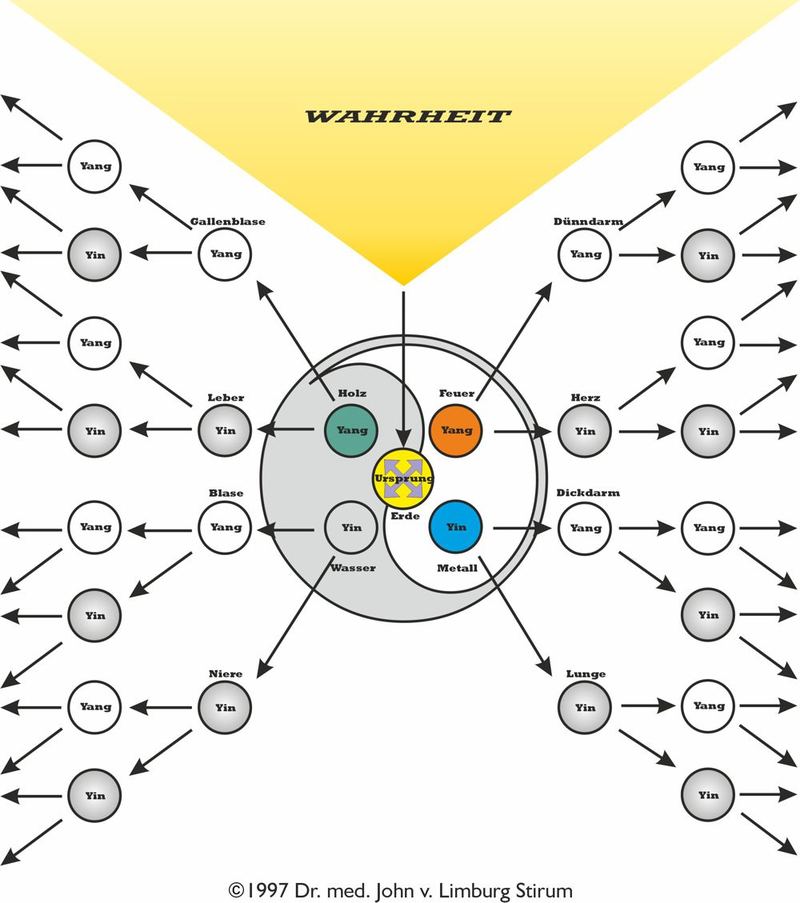
The universe is in constant change, movement as the result of an inner dynamic, just like the four seasons. Nobody would claim that spring is a consequence of winter. Rather, they flow into one another, and this cycle repeats itself eternally. Embedded in these climatic changes through their evolutionary history, all biological organisms analogously also pass through the four seasons: birth, maturity, decline, death. Thus four so-called “phases of transformation” (WP) arose. Together with the Earth as the “centre”, they became five. They represent a further basic principle of TCM (cf. table on the next page). the body as an image of the constitution of nature.
This comparative relationship with nature also led to illnesses being seen as interactions of the human being with climatic influences: stormy weather as a source of disharmony. These “pernicious influences” are six in number: wind, cold, fire, heat, dampness, dryness and summer heat.
However, the body is only susceptible to the harmful effect of these natural events when Yin and Yang are out of balance or weakened. Only then does wind, for example, penetrate the organism (first the surface; later, through incorrect or absent therapy, it can advance into the depths) and cause a wind illness (note: the disturbance is wind and the illness is wind, cause = effect!). In Western language this would be, for example, rheumatism (after a draught!), but also infectious diseases, since germs are carried by the wind. Even accidents are wind phenomena, since they too are based on movement. TCM works with a wealth of correspondences; thus wind is also associated with spring, when it occurs most. Since it embodies movement and our musculature is likewise responsible for our movement, the musculature also belongs to spring or the phase of transformation “Wood”, for that is the time when nature begins to grow (movement!). To the same phase of transformation belongs the character trait of the choleric person, who can flare up and, as it were, lash out. And just as our everyday speech has it that “a louse has crawled across his liver”, so the liver likewise belongs to this phase of transformation. Accordingly, it is also the most sensitive to wind influences (same phase of transformation). Similar considerations can be made for all the other WP.
| Wood | Fire | Earth | Metal | Water | |
|---|---|---|---|---|---|
| Season | Spring | Summer | Late summer | Autumn | Winter |
| Yin organ | Liver | Heart | Spleen | Lung | Kidney |
| Yang organ | Gallbladder | Small intestine | Stomach | Large intestine | Bladder |
| Climate | windy | hot | damp | dry | cold |
| Emotion | Anger | Joy | Worry | Grief | Fear |
| Taste | sour | bitter | sweet | pungent | salty |
| Sense organ | Eye | Tongue | Mouth | Nose | Ears |
| Tissue | Muscles | Blood vessels | Connective tissue | Skin | Bones |
| Colour | green | red | yellow | white | black |
| Direction | East | South | Centre | West | North |
The WP consist of an outer and an inner energy system, which are connected to one another. Therapeutically important for us is the outer system, which is built up from the acupuncture meridians familiar to us. These channels are lines that arise from mentally connecting the acupuncture points (AP). The channels represent conduits in which the energy (“Qi”, pronounced chee) and the blood (“Xue”, pron. shweh) are transported, and they are in no way comparable with the Western notion of blood vessels. Thus, by manipulating these points (by needling, moxibustion (warming), or acupressure, laser puncture etc.), Qi and Xue can be influenced directly. The AP also have individual relationships to the phases of transformation and thus also to the organs, and show different qualities, such as distributing, gathering, dampening, stimulating, etc. The art of body acupuncture (KAP) is to develop, for every disharmony (for us, illness), a strategy with this wealth of AP and to deploy them like chess pieces for the good of our health. However, just as a chess player can be defeated by his enemy, acupuncture need not take effect straight away. Under certain circumstances a different strategy is required. It is therefore premature to call acupuncture as such into question after unsuccessful acupuncture sessions, just as we would hardly doubt antibiotic therapy if it should fail to help on one occasion.
How can the body become susceptible to the above-mentioned pernicious influences? The main causes are unbalanced emotions, incorrect diet, sexual excesses, physical overexertion and “wrong therapies”. These factors should be addressed first, before an illness breaks out. Nei Jing says in a poetic manner:
“To apply medicine after an illness has begun,..… that is like digging a well only after one has become thirsty, or forging weapons only when the battle has already begun.”
Here it is always a matter of balance, rhythm and harmony. Food should be prepared and eaten in a balanced way: green leafy vegetables (a Yin substance) are cooked with ginger (a Yang substance). Special physical exercises (T'ai-Chi) promote rhythmic and controlled movement.
Diagnosis in TCM rests on 4 pillars: observing, questioning, palpating, listening and smelling, the first three being the most important. Foremost are pulse and tongue diagnosis, where the energetic processes become visible and palpable. The aim and art of the examination is ultimately to grasp and interpret the human being as a living painting, similar to the work of an art critic, in order to derive the individual therapy from it.
A course of acupuncture therapy generally consists of approx. 10 sessions lasting up to 30 minutes. Only disposable needles are used, in order to make the transmission of diseases impossible. The success of the treatment does not depend on the number of needles inserted. In view of what has been said above, however, the patient must be asked to report all changes and reactions to the physician, so that the therapy can be adapted to the new situation if necessary. As a “side effect”, a blood vessel may occasionally be pricked, which can result in a small bruise, but is completely harmless.
Just as nutrition is regarded as a remedy, Chinese herbal medicine is almost more important for TCM than acupuncture, since the latter can merely redirect and drain off the existing energy, but cannot supply any. In addition, KAP takes place at the surface of the body, while the medicinal herbs, by being ingested, penetrate directly into the depths. They also have different temperature qualities (hot, warm, neutral, cool, cold), taste qualities (bitter, sweet, pungent, salty, sour, bland) and relationships to the phases of transformation. A combination of effects can thus be achieved in a targeted way through an appropriate composition. Peppermint tea cools the body, even when it is drunk hot! At the same time it relates to the WP Metal or to the lung. So where there is too much “heat in the lung” (bronchitis with purulent sputum), we can use it to cool this disharmony successfully and support recovery.
Foundation of Chinese philosophy
Taste and its significance
| Salty | bitter | sour | neutral | sweet | pungent |
|---|---|---|---|---|---|
| Accumulation of fluids, condensation of substance | Provision of active energetic valences, unfolding of energy | ||||
| Generating fluids Hygroscopic Holding and gathering fluids Moistening Lowering Laxative Softening Dissolving | Drying Roughening Precipitating binding, clarifying, draining the fluids | Astringent Contracting Preserving fluids Roughening Constipating | Regulating the fluid balance stimulating the excretions | Supplying fluids Supporting Hygroscopic supplying, regulating, harmonising active energy Buffering | Unfolding Dissolving Opening mobilising active energy acting at the surface |
| Cooling, sprouting -> development of a salty sapor | Boiling, cooking, baking: increase and concentration of sweetness (vegetables and fruits that are sour when raw become sweeter when they are boiled or cooked or made into juice or compote). Industrial refining |
The thermal nature of foods and its significance
The thermal behaviour provides information about the energetic dynamics of a food.
Cold to hot
Slowing or acceleration of physiological processes by the dynamic Qi forces of the food. Qi movement strong or only slight
Thermal behaviour = Yang aspect, as it reflects an active energetic expression.
(cf. type of taste = Yin)
Hot, Warm, Neutral, Cool, Cold
This does not mean the temperature in degrees Celsius at which the food is served to us. It is the specific sensation of temperature that arises in us after eating it, or the thermal effect that unfolds. Here the transitions are fluid.
Cool, cold
Slowing, condensation, accumulation. Substance is replenished, fluids are made available. Morning dew on the meadow, condensation as on misted-up windows. Gathering of the material, processes are led downwards and deposited (Yin aspect) The cool ones drain heat off.
Supports the structive energies.
Raw food, salads, fruit, soft drinks, ice cream, banana, watermelon
Everything with ice from the refrigerator: cold shock
Warm, hot
Active unfolding, acceleration, dynamisation, hence dissolution, that is, a force directed against materialisation, dispersing, accelerating, lifting upwards. (Yang aspect)
The hot and warm ones compensate for cold and support the active energies.
Spices, lamb, beef, alcohol, chillies
Ideal for digestion: warm, neutral
If too hot -> qi flies out of the chimney.
Ideal for moistening: neutral, cool
“What is cool, one warms; what is warm, let one cool.”
I.e. in the case of cold symptoms one should eat warm or hot foods, in the case of heat symptoms cool or cold ones.
Neutral
Preservation, symbolises the centre, where moistening, gathering forces are in balance with moving, consuming ones. Unite both aspects, Yin and Yang, within themselves: supplying and preserving fluids, providing active energy.
Overview of foods and their thermal behaviour
| HOT | WARM | NEUTRAL | COOL | COLD | |
|---|---|---|---|---|---|
| METAL pungent resolves stagnation leads upwards | Herbs Cayenne pepper Chilli Curry Nutmeg Clove Pepper Allspice Star anise Tabasco Drinks Grain schnapps Whiskey Vodka Yogi tea | Grains Oats Vegetables Spring onion Leek Horseradish Onion Meat Pheasant Red deer Partridge Roe deer Quail Wild boar Dairy products Harz cheese Cheese, fermented Munster cheese Mould-ripened cheese Drinks Rice wine Herbs Basil Cumin Dill Ginger cardamom Garlic Coriander Caraway Lovage Bay leaf Marjoram Masala Chives Mustard | Meat Hare | Grains Rice Vegetables Kohlrabi Radish White radish Meat Goose Turkey hen Turkey cock Herbs Cress Drinks Peppermint | |
| EARTH sweet moistens relaxes distributes | Herbs Fennel seeds Cinnamon Drinks Fennel tea | Grains Amaranth Sago Sweet rice Vegetables Fennel Chestnut Pumpkin Sweet potato Fruit Apricot Currant Peach Raisin Sweet cherry Dairy products Coconut milk Herbs Amasake Vanilla Nuts / Seeds Pine nuts Pistachio Walnut Drinks Mead Liqueur Fortified wine | Grains Millet Maize Vegetables Cabbage varieties Dwarf beans Peas Carrot Potato Turnip Climbing bean Fruit Date Fig Plum Grape Meat Veal Beef Dairy products Butter Egg Cheese Cow’s milk Cream Herbs Saffron Sweeteners Honey Malt Marzipan Cane sugar Nuts / Seeds Peanut Hazelnut Coconut Almond Sesame Drinks Corn silk tea Malt beer Liquorice tea Grape juice | Grains Barley Yeast bread Vegetables Aubergine Avocado Cauliflower Broccoli Button mushroom Chinese cabbage Chard Sweet pepper Black salsify Celery Asparagus Spinach Courgette Fruit Apple, sweet Pear Honeydew melon Papaya Soya products Tofu Soya milk Herbs Tarragon Kuzu Arrowroot flour Sweeteners Maple syrup Nuts / Seeds Cashew nut Sunflower seeds Cooking oils Olive oil Sesame oil Soya oil Sunflower oil Wheatgerm oil Drinks Apple juice Vegetable juice | Vegetables Cucumber Fruit Banana Persimmon Mango Watermelon |
| WOOD sour preserves the fluids | Grains Green spelt Meat Chicken Herbs Vinegar Parsley Drinks Cherry juice | Grains Spelt Wheat Meat Duck Dairy products Curdled milk Fresh cheese Kefir Sour milk Soured cream Swedish milk Quark Raising agents Baking ferments Yeast Sourdough Vegetables Sauerkraut Sprouts Fruit Apple, sour Apple compote Blackberry Strawberry Bilberry Currant Orange Lingonberry Sour cherry Gooseberry Drinks Bread drink Champagne Fruit juice Rosehip tea Hibiscus tea Mallow tea Lemon balm tea Prosecco White wine Wheat beer | Vegetables Mung bean sprouts Sorrel Tomatoes Fruit Pineapple Kiwi Rhubarb Lemon Dairy products Yoghurt | ||
| FIRE bitter dries out leads downwards | Meat Mutton Lamb Sheep Goat Grilled meat Herbs Fenugreek seed Drinks Bitter liqueur Cognac Mulled wine | Grains Buckwheat Dairy products Sheep’s cheese Goat’s cheese Goat’s milk Herbs Mugwort Turmeric Cocoa Poppy seed Oregano Hot paprika Rosemary Thyme Juniper berry Drinks Grain coffee Coffee Red wine | Vegetables Lamb’s lettuce Brussels sprouts | Grains Rye Vegetables Artichoke Chicory Iceberg lettuce Endive Green lettuce Dandelion Olive Parsnip Radicchio Beetroot Fruit Elderberry Grapefruit Quince Herbs Sage Drinks Altbier | Drinks Gentian tea Lady’s mantle tea Green tea Burdock root tea Dandelion root tea Pils Yarrow tea Black tea Vermouth |
| WATER salty softens leads downwards | Fish Eel Perch Trout Prawn Lobster Cod Salmon Spiny lobster Mussel Plaice Shrimps Anchovy Tuna Smoked fish | Pulses Aduki bean Pea Lentil Red soya bean Broad bean Fish Carp | Pulses Yellow soya bean Chickpea Black soya bean Fish Calamari Cuttlefish | Seaweed Iziki Kombu Nori Wakame Pulses Mung bean Fish Oysters Caviar Herbs Agar-agar Miso Salt Soy sauce Drinks Mineral water |
Influencing food temperature
I can also influence the food temperature by cooking.
| Colder | Cooler | Neutral | Slightly warmer | Markedly warmer | Heating |
|---|---|---|---|---|---|
| Preparation in the kitchen | |||||
| Freezer compartment Ice cream, sorbet Drinks with ice cubes | Soaking in water Leaving to swell Leaving to sprout | Making juices, possibly with sugar Syrup, possibly with sugar Compote, possibly with sugar Mash Purée Pulp Chopping finely Grating, e.g. apples, carrot Mincing, putting through the mincer | Boiling Stewing in water Steaming Braising Blanching | Baking Grilling Roasting Frying Deep-frying Braising in fat Braising in wine Alcoholic preparation | |
| Preservation | |||||
| Serving cool and cold Pickling in salt Curing | Chilling Steeping in soy sauce Steeping in oil | Fermentation Fermenting (yoghurt, tofu) | Drying (dried fruit, dried fish) Bread-making Yeast dough Sourdough Shortcrust pastry | Pickling in vinegar Steeping in wine | Alcoholic preparation |
| Industrial preparation | |||||
| Milling (grain flour) Hulling, polishing (rice, grains) | Refining (refined flours) Sugar refining with simultaneous drying |
Chewing is also warming!!! Or seasoning etc.
A chilli pepper will still be hot by temperament even when it is taken out of the refrigerator, and a glass of buttermilk is still cool even when it has been warmed.
Manipulation leads to different thermal and biological behaviour. Taste is largely preserved. It is only less pronounced when cold, or rather, through heating the taste becomes more pronounced.
Usual here: very cold drinks and meat on the grill, roasting -> very hot. All extremes! No neutral foods.
Fruit: cool, as rich in water, Yin. Pressed juice + sugar + cooking -> warmer
Apple raw = cool -> possibly diarrhoea. Grated, cooked -> warmer -> against diarrhoea!! Possibly also with cinnamon -> even warmer.
Food additives + processing -> different energetics
The sensation of taste gives information about where a food acts: at what depth, layer, level. Tendency of action.
We take the term “taste” from the translation of the Chinese word, which denotes both the taste (the nature) of these particles and the particles themselves, which have a particular taste. Taste comparatively stable and difficult to influence (Yin), whereas the thermal behaviour can easily be changed by the various methods of preparation such as cooking, freezing etc., which corresponds to the yang aspect.
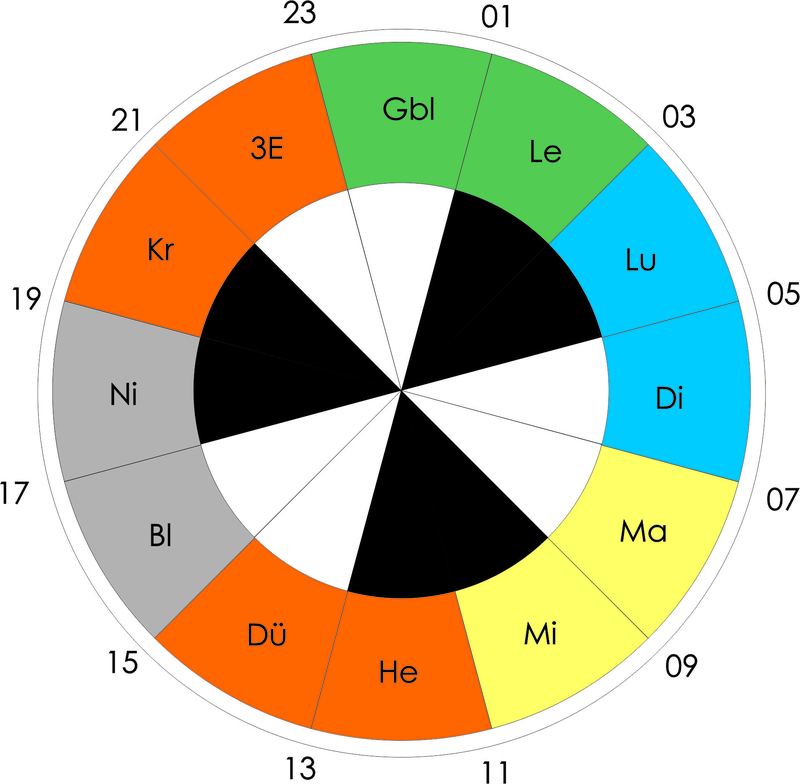
Organ clock
Tea - preparation
- From the herbal mixture a tea concentrate is prepared, which is to be drunk spread over a certain number of days and kept in the refrigerator.
- Put the contents of the bag into approx. 1 litre of cold water and, where applicable, soak according to the instructions on the bag.
- After soaking, bring to the boil. Continue boiling over a low heat according to the instructions on the bag. Do not use an aluminium pan. Set a kitchen timer. Caution! The decoction tends to boil over. Adjust the heat so that the herbs are swirled around well. Depending on the instructions, you first boil the contents for 15 minutes, allow them to cool a little and heat them again for approx. 20 minutes.
- If you have received an additional small packet, add its contents towards the end of the boiling process according to the instructions on the bag.
- Strain the boiled mixture and press it out a little.
- Leave the decoction to stand for a while so that dust, sand and small plant particles can settle.
- Pour the decoction into a 1-litre bottle, discard the sediment.
- Top up this bottle with freshly boiled water that is hot but no longer boiling. The concentrate is then ready.
- If the concentrate is intended for 5 days, take 2 dl of it daily, diluted with freshly boiled water to a daily amount of 3-5 dl.
- This “tea” is now to be drunk in sips spread over the day. It should not be sweetened. Do not drink it with meals and not after 19.00, unless something else has been specified.
- If anything is unclear, if the tea is undrinkable or if symptoms worsen, you must contact me and stop the tea in the meantime.
- The appearance of the mixture may occasionally vary, depending on how finely the delivery has been cut.
According to the teaching of Chinese medicine, a medicine is to be taken only for as long as it is also accepted by the body. It may even happen that the instinctive desire for the tea increases. In this case the prescription is to be dispensed again. If the opposite is the case, however, the tea may already have fulfilled its task, and a different mixture corresponding to the new requirements of the organism is needed.
SUPPLYING PHARMACIES
(a selection!)
Bollwerk Apotheke
- A. Kilchherr
- Bollwerk 15
- 3011 Bern
- Tel.: 031-3111731
- Fax: 031-3116052
St. Peter Apotheke
- Silvia Briggen
- St. Peterstr. 16
- 8001 Zürich
- Tel.: 044-211 44 77
- Fax: 044-212 04 91
Berg Apotheke
- Max Bandle
- Stauffacherstr. 16
- 8004 Zürich
- Tel.: 044-241 10 50
- Fax: 044-291 33 19
Schloss-Apotheke
- Dr. M. Natalia
- Zürichstr. 1
- 8610 Uster
- Tel.: 044-940 35 11
- Fax: 044-940 35 12
Preparing the formula generally takes one day. For this reason it is advisable either to send the prescription by post first or to fax it. Of course it can also be brought in personally and the mixture collected the next day. Dispatch by arrangement.
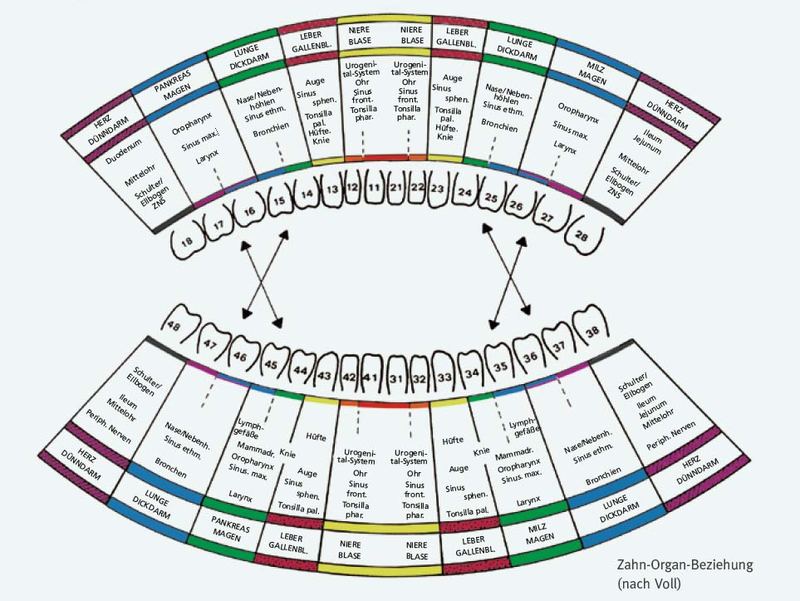
Teeth - organs