Recognising and treating iron deficiency
Tiredness, exhaustion, headaches or hair loss can be signs of iron deficiency — especially in young women.
Why is iron important for the body?
In its atomic form, the element iron is responsible for transporting oxygen from the lungs to the organs. Nothing else can take its place. Atomic iron is also closely involved in more than 180 metabolic processes in every one of our 33 trillion body cells.
Common symptoms of iron deficiency:
- Exhaustion and tiredness
- Poor concentration
- Sleep disorders
- Depression
- Headaches and neck pain
- Hair loss
- Dizziness
- Restless legs at night
Causes of iron deficiency:
- Heavy monthly periods in women
- Growth, poor diet
- Bowel problems
- Accident injuries with major bleeding
- Blood cancer and other tumours
- Bone marrow diseases
- Kidney problems
- Extreme sports
- After major surgery
- Blood donation
Our services: Iron Centre, Seegarten Klinik Kilchberg
Iron deficiency can lead to a wide range of distressing symptoms that considerably affect everyday life. At the Iron Centre of Seegarten Klinik, we offer precise diagnostics, individually tailored therapies and comprehensive aftercare.
Our experienced team supports you on the way to more energy and well-being – with state-of-the-art methods and many years of expertise.
Diagnosing iron deficiency:
A careful medical history with specific questions about typical symptoms, a blood sample and laboratory diagnostics. You then receive comprehensive information about iron deficiency, including answers to your questions.
Iron infusions – an effective therapy:
If iron tablets or syrups are not tolerated or are not effective enough, iron infusions become necessary, even in children.
The noticeable, positive effect of infusions comes very quickly, whereas oral iron medication takes months to start working. Infusions are not affected by absorption problems in the gut – and they have none of the typical side effects of iron tablets, such as constipation or stomach upsets.
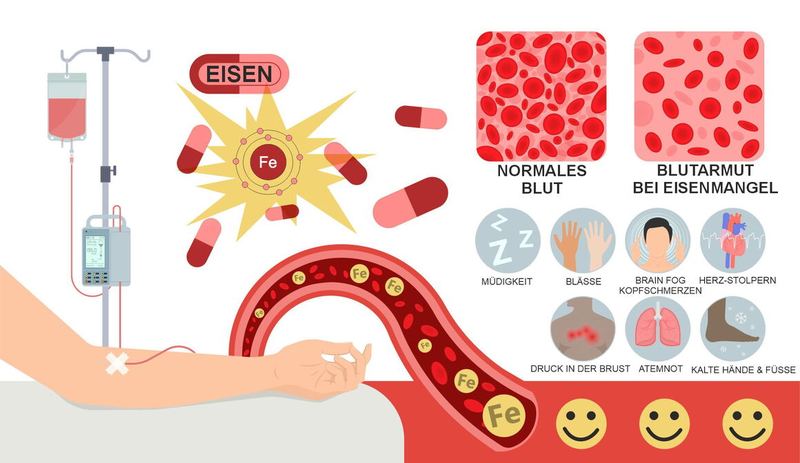
How an iron infusion works at our clinic: once the ferritin level and deficiency symptoms have been established, the patient is given an infusion appointment as soon as possible. The infusion is medically supervised and takes 45 to 60 minutes.
Aftercare and monitoring: three to six weeks after the necessary series of infusions has been completed, the peak ferritin level is checked and you are asked about any improvement in symptoms. The next steps are decided on the basis of this laboratory value and the course of the symptoms. Your very individual ferritin well-being level is the benchmark for further iron maintenance infusions. Regular check-ups every three to six months help to secure the success of the treatment and to adjust further treatment.
Why the Iron Centre of Seegarten Klinik (SGK)?
Holistic and individual treatment of iron deficiency
At the Iron Centre of Seegarten Klinik, we take your complaints seriously. We rely on precise diagnostics and tailored therapy, based on the proven iron system of the Swiss Iron Health Organisation (SIHO). This allows lasting treatment and the best possible care for every patient.
Fast and effective help
Thanks to our in-house laboratory, we can diagnose iron deficiency quickly and arrange an infusion appointment as soon as possible. Our iron infusions are given with the utmost care and with the most suitable preparations, to ensure optimal tolerance and effect.
Lasting therapy for long-term well-being
We not only determine your individual ferritin well-being level, but also support you in the long term with targeted maintenance infusions. In this way we prevent renewed deficiency and make sure that you feel better for good.
Expertise and experience
For more than 20 years we have been researching and treating iron deficiency in adults and in children from the age of 6. Our expertise enables well-founded and safe therapy, even in complex cases.
Holistic assessment and therapy
Should it turn out that your symptoms are not caused by iron deficiency, we offer you comprehensive assessments in both conventional and natural medicine – all under one roof. For these reasons too, SGK is a place of broad medical research and teaching, where experience sometimes allows a fresh position to be taken on controversial topics.
Central location and easy to reach
Seegarten Klinik in Kilchberg is just 17 minutes by S-Bahn (suburban train) from Zurich main station, right next to Kilchberg station. It is easy to reach by car (approx. 15 minutes from Zurich) and conveniently by public transport such as the S-Bahn, bus and lake steamer (Kilchberg landing stage). You will find further information on our contact page.
A better quality of life through the right treatment
With the right treatment for iron deficiency, you spare yourself unnecessary visits to the doctor, lengthy mistreatment and persistent complaints. This saves not only time and energy but also costs, as many separate assessments and symptom-based treatments become unnecessary. Our aim is to help you quickly, holistically and lastingly – for a better quality of life and more efficient healthcare.
Experiences from the Iron Centre Zurich
Whether from the point of view of our patients or our doctors – real experiences often say more than any theory. Read personal accounts and medical case studies that show how targeted treatment of iron deficiency can change lives.
The 6 iron nails from you and your nutritional advice seem to have paid off! I had an appointment with my internist. He had my ferritin measured again. It is now at 40. I know people who took iron supplements for a whole year, but it did not raise their ferritin level.
Absorbing iron naturally (in German)
A patient who had suffered from severe depression for years had to be admitted to a psychiatric hospital because outpatient treatment was getting nowhere. The depression remained resistant to treatment during her stay, and she was discharged. Only after her very low iron stores had been replenished did the depression disappear, and she was able to stop taking antidepressants.
Case report by Dr. med. Peter Meyer Iron Centre
The entire team of doctors is exceptionally competent, warm and committed. You feel taken seriously, because everyone takes a lot of time, listens attentively and responds to your concerns individually. I was particularly impressed by the holistic approach, in which causes are carefully analysed rather than just treating symptoms. A big thank you to Dr. and Mrs Meyer and the whole team! Our children received a comprehensive analysis that identified vitamin and mineral deficiencies. Based on this, an individually tailored treatment was recommended – which gives us a very good feeling. Appointments are given quickly, reminders are sent reliably and laboratory results arrive promptly. The atmosphere in the clinic is also very pleasant. We feel very well looked after in every respect and recommend this clinic wholeheartedly.
Luis Aquino
I am absolutely delighted with the treatment I received from Dr Meyer. The advice was extremely competent, and the treatments really helped me a great deal – I feel much better. I particularly appreciate that I received not only medical care but also many valuable tips for my general well-being. The whole team, including Dr Meyer, was very friendly and committed. I felt I was in excellent hands and can recommend the practice wholeheartedly. Five stars!
Marco Cocuzza
One of our medical practice assistants had been trying to become pregnant for years. Because of polycystic ovary syndrome, she had not had a period for more than ten years. After her iron reserves were properly replenished for the first time, her periods returned, and she went on to become the happy mother of two healthy children.
Case report by Dr. med. Peter Meyer Iron Centre
Dear Dr Stirum, I wanted to take this opportunity to thank you and let you know how well I have been feeling again since the iron infusion! I have more strength in training again and no longer get exhausted so quickly (my pulse no longer goes through the roof straight away, either). I suspect my "feel-good threshold" is not necessarily at 50 but more like 80. I don't eat meat, train 3–5 times a week and still have regular periods. Many thanks for your help, and kind regards.
Frequently asked questions (FAQ) about iron deficiency
Iron deficiency: what does treatment involve?
With very low ferritin levels (e.g. below 20), a better diet and/or oral iron medication will hardly ever bring quick success. Only infusions can markedly shorten the period of suffering.
Definition of iron deficiency
It is not the iron level but the ferritin level that matters. The normal ferritin range varies from 10 to 350 nanograms per millilitre of blood. With such a wide range, it is necessary to find out the patient's individual ferritin well-being level. Experience shows that in most women the symptoms of iron deficiency only disappear in the upper part of the normal range. So it is not helpful to go by the lower limit of normal alone.
Causes: how does iron-deficiency anaemia develop?
If the signs of incipient iron deficiency are ignored or misread, a patient with a very low ferritin level can also slide into anaemia, with additional symptoms such as shortness of breath and a racing heart. Severe bleeding from injuries or childbirth can also lead directly to anaemia.
Why don't iron-rich foods or tablets help my iron deficiency?
Many patients wonder why their iron levels do not rise despite an iron-rich diet or tablets. The reason often lies not in iron intake but in iron absorption – the body's ability to take up iron in the gut at all.
In fact, only about 10% of the iron consumed (whether from red meat or, for example, iron tablets) is absorbed through the digestive tract. The right environment in the gastrointestinal tract is crucial:
- Absorption works best in an acidic environment.
- Anyone taking milk, alkalising agents or so-called stomach protectors (acid blockers) significantly reduces absorption.
- On the other hand, acidic drinks containing vitamin C, such as apple or lemon juice (unsweetened), are recommended, as they can promote absorption.
Despite every dietary optimisation, however, many of those affected see no effect. In such cases, an intravenous iron infusion is often the most effective solution – fast-acting and independent of the gut. Many patients report a noticeable "wow effect" shortly after the first infusion – more energy, better concentration and a greater sense of general well-being.
Why is the ferritin level so important in diagnosing iron deficiency?
The serum ferritin level is the most specific marker in diagnosing iron deficiency and correlates best with clinical symptoms – not free iron! Ferritin is a protein that stores iron, so a low ferritin level usually indicates that the body's iron stores are depleted.
There are exceptions, however: in acute or chronic inflammation – such as flu, colitis or other inflammatory diseases – the ferritin level can be artificially raised, because in such situations the liver produces additional ferritin, regardless of the actual iron stores.
That is why we always assess the ferritin level in the overall context of your symptoms, laboratory values and medical history. This ensures that the diagnosis is reliable and individually well-founded.
Take the iron deficiency test
The more questions you answer with yes, the more likely iron deficiency becomes.
- Do you have trouble concentrating or remembering things?
- Do you take medication: stomach protectors, painkillers (NSAIDs)?
- Do you suffer from headaches, dizziness or muscle tension?
- Do you have pale skin or pale mucous membranes, or do you feel the cold easily?
- Are you prone to hair loss or brittle nails?
- Do you suffer from sleep disorders?
- Do you have restless legs when falling asleep (restless legs syndrome)?
- Do you tend towards a low or depressed mood?
- Do you do intensive sport (more than 12 hours of training a week)?
- Are you vegetarian or vegan?
- Do you have a chronic illness (e.g. rheumatism, heart failure)?
- Do you suffer from tiredness bordering on exhaustion?
- If you are a woman: are your periods heavy or long-lasting, or have you recently given birth?
We will be happy to advise you in our consultation on…
- How iron deficiency can be detected.
- How you can optimise iron absorption naturally through your diet.
- How iron preparations in the form of tablets or infusions can help you.