Did you expect more from your last check-up?
Choose your personal diagnostic and preventive priorities – together with the doctor – from a most comprehensive functional check-up programme.
The various comprehensive SGK check-ups give you in-depth insight into your health, with detailed recommendations for prevention, performance and better ageing.
Thanks to modern methods in holistic medicine, we are now able to significantly improve general well-being and resilience. At the same time, you are practising better ageing at the highest level. Your body feels better – and with it your personal presence, your attractiveness ("You're looking well!") and therefore your chances of success.
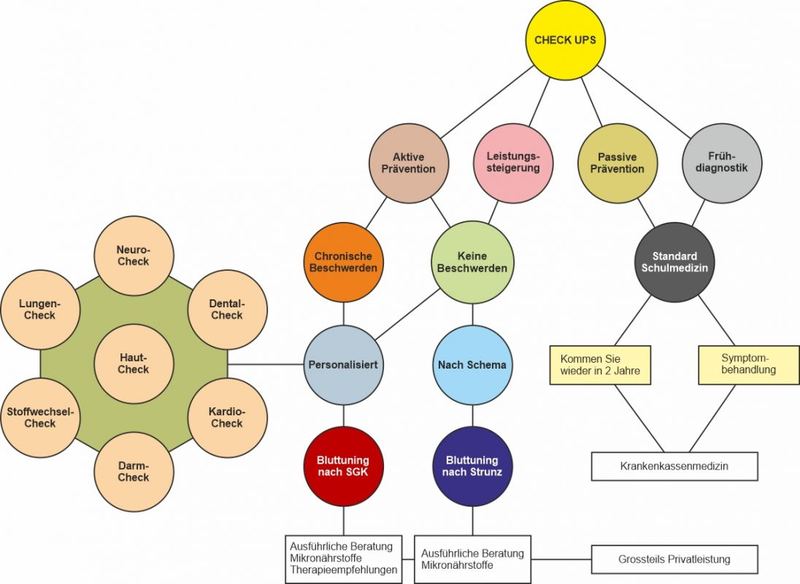
Together with specialists, Seegarten Klinik has developed a highly individual approach that goes much further than the usual standardised check-ups (so-called check-up packages).
Not only are risk factors detected that the usual analyses miss, but health programmes can be drawn up that turn a passive screening ("come back in two years"...) into active prevention. Combined with modern environmental-medicine diagnostics, genetics and/or epigenetics, this most comprehensive form of prevention leaves little to be desired within what is possible today.
Seegarten Klinik check-ups therefore include:
- A detailed account of your state of health
- A thorough physical examination
- Detailed concluding consultations
- Treatment proposals
Additional individual examinations and analyses as required:
- Cardio check with ECG, echocardiogram, exercise ECG
- Lung check
- Vascular check with ultrasound
- Neuro check incl. nerve conduction study and cerebral vessel check
- Skin check
- Gut check
- Metabolic check and obesity advice
- Body composition
- Dental check
Costs
Check-ups may be covered by supplementary insurance. Many companies also contribute to the health of their employees. Please ask your insurer or your employer.
Where there is a medical need, services are reimbursed by health insurers. Exceptions are assessments in the field of integrative medicine; these are partly covered – if at all – by supplementary insurance. A check-up purely for prevention, depending on the scope you want: CHF 800 – 2,000, which will be discussed and decided together at the first consultation. Depending on individual needs, costs may be higher or lower.
What happens as a new patient
Day 1: Initial consultation to order the assessments tailored to you. Duration approx. 30 minutes
Day 2: Laboratory appointment. Duration 15 (usually) to 60–120 minutes, depending on what has been ordered
Day 3 (1–2 weeks later): Doctor's appointment. Examination, possibly a cardiovascular exercise test, discussion of laboratory results and advice
Individual variations are of course possible.
What happens next?
We need to distinguish between 4 situations:
- Patient has no complaints
- All tests normal
- Tests not normal
- Patient has complaints
- Tests normal
- Tests not normal
1.A) Under these conditions, living circumstances can be analysed further, and any stress factors weighed and eliminated accordingly. In ideal circumstances no further steps may be needed, and we may agree to repeat the examination in a few years.
Standard interval
- 20–40: every 10 years
- 40–50: every 5 years
- 50–70: every 2 years
- 70 and over: every 1–2 years
For particularly "proactive" people, there are now various additional preventive measures to minimise the likelihood of health problems. It should be stressed once again, however, that the primary aim is not to add "years to life" but "life to years". Statistically, we spend only two-thirds of our life on earth free of complaints.
The most important and least expensive preventive measures are diet, exercise and relaxation. Prevention can also be supported by special procedures, for example the use of vitamins and minerals, hormones, chelation therapy or – thanks to the latest research – even your own stem cells, taken from the skin and cultivated for later use in case of illness.
1.B) The implications of the abnormal results and the corresponding measures are explained. Based on this information, the patient has to decide whether to go ahead with them, even though they may not necessarily feel "better" afterwards, having had no complaints in the first place.
2.A) This scenario is rare. As a rule, further assessments can be carried out, thanks to the wide range of analyses available at SGK together with our partners.
2.B) Here the aim is to cure the illness as far as possible by addressing its causes. The suitable treatments are explained and carried out with the patient's consent.