This page explains why root-treated, dead teeth can place a burden on the organism, how such a dental focus develops over the years, how we assess it and what matters when it is removed.
Why dead teeth are a burden
It is not only amalgam that can harm us. Substances from bacteria in gum diseases and in infected, dead, root-treated teeth are often an even greater burden on our organism. The picture above shows such a tooth, which has turned black over the years. Black is, after all, the colour of death, and in the worst case this “death” can spread, through the bacteria as well as through their toxins. With the crown, the dead tooth is, so to speak, hidden. Because the gum has receded, the black root has come to light again.
Dr William Hunter, an eminent dental researcher at the beginning of the 20th century, would have put it like this, borrowing from his own words: “A mausoleum of gold over a mass of sepsis”.
The best-researched toxic substances are reactive sulphur compounds such as hydrogen sulphide (H2S) and methyl mercaptan (CH3SH), which are produced by the bacteria in non-vital teeth. Prof. Boyd Haley of the University of Kentucky (USA) has also found that the overall toxicity multiplies when mercury and non-vital teeth are present in the mouth at the same time: the individual substances react with one another to form “super-toxins”.
Tooth substance under the electron microscope
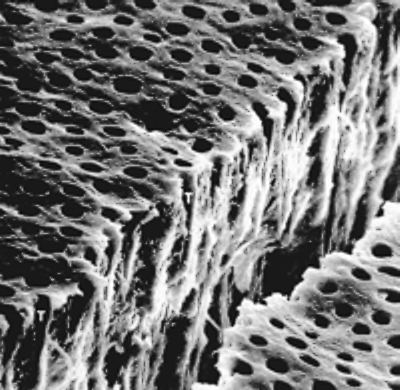
Countless bacteria live in these canals of non-vital teeth. The bacteria in the dentine canals of the dead teeth can hardly be reached with antibiotics and local disinfectants and are therefore practically impossible to kill. They form a constant reservoir for bacterial infections, reinfections and bacterial toxins.
When the dentist wants to “save” the tooth
Be on your guard if your dentist suggests the following to you:
- “We will do a root canal treatment so that your tooth lives longer.”
- “I will try to save the tooth.”
These statements mean that the tooth is actually killed and will remain in the mouth for an indefinite time as a lifeless form and decay there. There is no other medical speciality that would leave something dead behind in the body!
How a dental focus develops
The development usually extends over many years.
- The tooth is dead. No complaints.
- Zones of bacteria form and are encapsulated by the body. No complaints.
- Metabolic toxins spread and penetrate the body. No significant complaints, because the body’s defence mechanisms are sufficient to neutralise the burden.
- The influx of toxins increases, and the body is gradually overwhelmed. Increasing complaints, lack of drive, need for sleep.
- The patient becomes chronically ill.
The possible, scientifically proven consequences are:
- Heart infections and heart attacks
- Strokes
- Raised blood pressure
- Arteriosclerosis
- Eye conditions
- Pneumonia
- Blood diseases
- Joint inflammation
- Infections of joint implants
- Brain abscesses
- Low birth weight and premature births
- Alzheimer’s
Assessment
Panoramic X-ray (OPT)
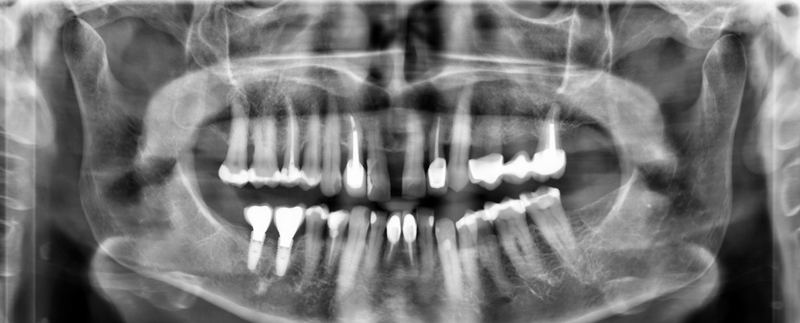
An important aid for rapid orientation in the jaw and tooth area is the panoramic X-ray (orthopantomography, OPT), on which all the teeth are clearly shown. The teeth with a thin post are root-treated and dead. The broad posts are implants and are usually biologically neutral.
OroTox test
The sulphur compounds from dead teeth can be detected with the OroTox test. The test checks teeth for their toxicity and is a result of the 35 years of research work by Prof. Boyd Haley.
The OroTox test
- Detects problem areas in the mouth at an early stage, years before changes become visible on the X-ray and irreversible damage to teeth and health has occurred,
- Helps with the decision as to whether a root-treated tooth must be extracted or may be restored and crowned, above all when no changes can be seen on the X-ray,
- Monitors the course and the success of therapeutic measures,
- Enables patients to keep their teeth without bacteria and their toxins spreading into the organism.
Procedure: A fine paper point is inserted painlessly into the gum pocket and left there for one minute. It absorbs fluid from the gum pocket and is then placed in special reagents. The tooth toxins and inflammatory proteins can be detected by a change in colour.
Preparation: Please come with your teeth cleaned. Clean them with water only, without toothpaste, and at least one hour before the examination appointment. After a visit to the dental hygienist, at least 2 weeks must be allowed to pass. An important prerequisite for the analysis is an X-ray of the teeth, ideally an OPT.
What to do if there is a burden
If such a burden is found, removal of the tooth or teeth must be considered, above all if there are corresponding clinical symptoms. In the case of gum diseases, however, a thorough dental cleaning must be carried out first; after about 2 weeks the OroTox test is repeated. If the result is poor, the only longer-term solution is to have the tooth extracted.
The biological extraction of a devital tooth
- Do not extract the tooth straight away, but merely loosen it and allow it to bleed into the socket. The bleeding loosens the tooth further, and at the same time the blood serves as a “lubricant”. After a few minutes the tooth can be removed without any further force.
- This also reduces the risk of a porous devital tooth breaking off during extraction.
- For effective bleeding of the socket, vasoconstrictors should be dispensed with if possible.
- After the extraction, allow the bleeding to continue so that the toxins are flushed out of the surrounding bone.
- In addition, curette the socket thoroughly so that the bone soaked with toxins is also removed and no longer places a burden on the organism.
These measures also reduce the danger of the procedure spreading bacteria.
Experiences of patients with a dental focus
- Woman, aged 68. Diabetes, rheumatic complaints. Treatment: removal of the root-treated teeth that reacted in the OroTox test. Result: the blood sugar fell so far that insulin therapy became unnecessary; the rheumatic complaints have practically disappeared.
- Man, aged 53. Tonsillitis four times a year, a bothersome sensation in the left upper jaw. Treatment: removal of one root-treated tooth. Result: tonsillitis markedly less frequent, now only once a year; the bothersome sensation in the upper jaw has disappeared.
- Woman, aged 55. Severe facial eczema, treated by conventional medicine with an unsatisfactory result, and recurrent maxillary sinusitis. Treatment: dental clean-up (root-treated teeth and amalgam removed). Result: facial eczema gone, no more medication, no further maxillary sinusitis.
- Woman, aged 60. Chronic conjunctivitis in the left eye, eye drops for years. Treatment: the root-treated tooth lying below it, which reacted strongly in the OroTox test, was removed. Result: the eye turned white again while she was still in the dentist’s chair. Free of complaints.
- Woman, aged 35. Recurrent pneumonia, joint pain, states of exhaustion, fever and a taste of pus in the mouth. Treatment: removal of three non-vital teeth that reacted strongly in the OroTox test. Result: no more pneumonia or joint pain, more energy, taste of pus gone.
- Man, aged 64. Recurrent prostatitis. Treatment: removal of one non-vital tooth. Result: PSA marker back to normal, no more prostatitis.
- Man, aged 43. Cardiac arrhythmia, soft-tissue rheumatism, total exhaustion; until then beta blockers, antirheumatic drugs and stays at health resorts. Treatment: removal of all non-vital teeth. Result: free of complaints.
- Woman, aged 60. For 10 years recurrent swellings on the body and in the face; until then antihistamines and cortisone. Treatment: removal of one tooth that was suspect in the OroTox test. Result: free of complaints.
- Woman, aged 75. Chronic exhaustion, rheumatism. Treatment: removal of the teeth in the upper jaw that were suspect in the OroTox test. Result: rheumatism markedly better, more energy.
- Woman, aged 37. For 6 years a childless marriage, smell of sweat. Two of three non-vital teeth showed raised values in the OroTox test. Result: after the removal of these two teeth the patient became pregnant in the same month, and the smell of sweat disappeared.
- Man, aged 54. Polyarthritis. Statement by the rheumatology department of a university hospital in 1987: “You will soon end up in a wheelchair.” Shortly afterwards, treatment with us with dental clean-up and detoxification infusions. Result: at the age of 76 the patient still works full-time in his workshop on precision machines, absolutely free of pain. Walking distance 5 kilometres, he can hop and dance. Back then in hospital, the walking distance, in pain, was about 20 metres.