Plasmapheresis / detox apheresis
In a therapeutic plasmapheresis, blood is separated with the aid of a filter into its components, blood plasma (the liquid part of the blood) and blood cells. In plasmapheresis, blood is taken from one of your veins via a tubing system and mixed with an anticoagulant (as a rule heparin). Your treating doctor will establish beforehand whether placing a catheter is advisable. Depending on the plasmapheresis procedure chosen, you receive the cleansed blood plasma back, or the quantity of plasma removed is discarded and replaced with human albumin or fresh plasma. The remaining blood components such as blood cells and platelets flow back into your bloodstream.
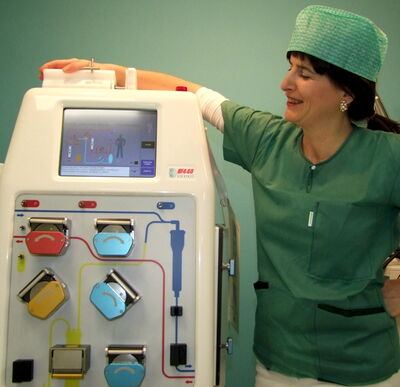
The plasmapheresis treatment is carried out with a special device using sterile single-use tubing systems, which are discarded after each treatment. A slight loss of proteins (including clotting factors) cannot be avoided during a plasmapheresis treatment; the clotting ability of the blood may be impaired as a result. However, these factors can be regenerated within a few days or replaced by giving fresh plasma.
After the treatment, physical performance may be reduced. We recommend a rest period of at least 60 min after apheresis. The ability to operate machinery is limited on the day of the withdrawal. High-risk activities (e.g. diving, mountaineering, parachuting etc.) may only be resumed on the following day.
During a blood filtration lasting approx. 2 hours, certain blood components are removed, depending on the indication, from the bloodstream and consequently also from the tissue of the internal organs and the skin:
- Immunoglobulins (antibodies)
- Immune complexes
- Fats
- Hormones
- Proteins
- Toxins
The principle of plasmapheresis
Via an access in the arm vein, the blood is passed through a nano filter. Here the plasma is separated. The cleansed plasma together with the red blood cells is returned to the body in the same treatment.
Indications
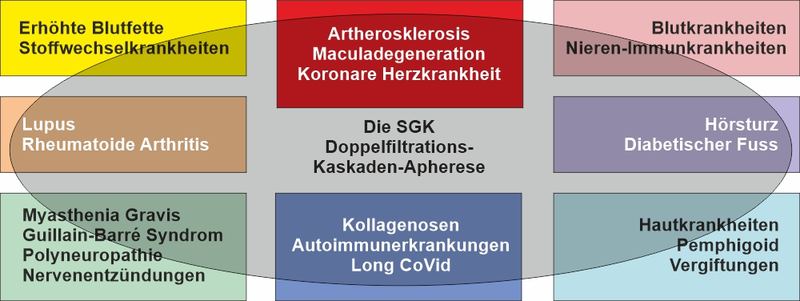
The clinical efficacy of plasmapheresis has demonstrably proved itself in the following diseases:
Central nervous system
- MS multiple sclerosis
- Hepatic encephalopathy
- Degenerative diseases of the brain
- Parkinson’s disease
- Alzheimer’s dementia
- Neuroborreliosis
Lung
- Bronchial asthma
- Chronic bronchitis
- Pulmonary fibrosis
Gastrointestinal tract
- Chronic inflammation of the stomach
- Chronic inflammation of the pancreas
- Chronic inflammation of the gallbladder
- Ulcerative colitis (inflammation of the bowel)
Skin conditions
- Neurodermitis
- Psoriasis
- Herpes zoster
- Lupus erythematosus
Heart diseases
- After a heart attack
- Hypertension (raised blood pressure)
- Viral inflammation of the heart
- Autoimmune disease of the heart muscle
Rheumatic disease
- Rheumatoid arthritis
- Polyarthritis
Other
- Autoimmune disease of the thyroid such as Hashimoto’s, Graves’ disease
- Dry macular degeneration
- Raynaud’s syndrome
- Progressive scleroderma
- Lupus erythematosus
- Hay fever
- Prostatitis
- Tinnitus
- Hypercholesterolaemia
- Allergies to medicines and foods
- Chronic bacterial and viral infections
- Chronic recurrent infections of the urogenital tract
- Infections with chlamydia, mycoplasma and in CMV infection
- Pyelonephritis
- Drug dependence and alcohol abuse
- Fibromyalgia
- As an accompaniment to cancer and chemotherapy
Treatment plan
As a basic treatment, at least 2 appointments are advisable. As a rule one begins with one therapy session in order to check the effect. Depending on the severity of the disease, follow-up treatment once a month, every 3 months, twice a year, or even just a single basic treatment is necessary.
Patient feedback
Dear Ms Weiss,
It is unbelievable, I already felt it during the apheresis, but today I am fitter than I have been since 2013!
I cleared out my daughter’s room, did laundry all day, went shopping, made lunch and supper, tidied the kitchen, started clearing out my son’s room, and I am still not exhausted, (only between 15.00 and 16.00 do I still notice a slump, not so bad any more that I have to take a siesta, but it is still there… that would then be the time of the bladder and the energetic preparation of the kidney, which work hardest at this time, and the lung, which then works at its weakest, and the large intestine, which is preparing energetically to wind down … psyche a few octaves higher than before…
Many heartfelt thanks
Love