In neural therapy, a low-dose local anaesthetic (which makes an area locally numb) is injected into particular areas of skin. Physical complaints that have arisen from an irritation zone (e.g. from a scar) can often be cured or relieved astonishingly quickly in this way.
A.H. has suffered from cardiac arrhythmia for many years. Because the conventional medicines used so far have failed, heart surgery is being considered. On questioning, it turns out that the symptoms began after an operation for a fracture of the lower leg. While (!) a neural therapy agent is being injected into the scar, the arrhythmia disappears instantly. What has happened?
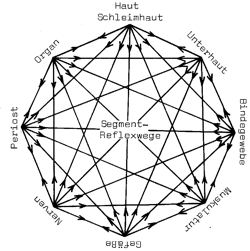
The basis for understanding this is the human autonomic nervous system, a vast network of lines with an unimaginable total length of 450,000 kilometres. Through this network, each of our forty trillion cells is interwoven with every other cell to form a living, communicating whole. Vital processes such as breathing, blood circulation and body temperature are partly controlled here. In this network, however, disturbances can also spread and trigger complaints at distant sites. The symptoms are diagnosed as a disease, but the actual cause goes unrecognised. It can be assumed that up to 20 per cent of chronic diseases are triggered, or at least promoted, by such irritation zones.
What are irritation zones?
Irritation zones are areas of pathologically altered tissue that constantly send out very fine impulses to the autonomic nervous system. Over time, these constantly recurring stimuli can cause complaints in the body.
Irritation zones often arise after surgical procedures, injuries or infections. The most common are therefore scars (even the smallest, barely visible ones), diseased teeth, tonsils (including those that have been operated on), irritated paranasal sinuses, the female lesser pelvis (a contributing origin of many conditions such as menopausal complaints, period pain, heavy bleeding, cycle-dependent headaches, discharge, bladder infections and others), foreign bodies and zones of bacteria. For doctors who practise neural therapy it is therefore enormously important to know the patient’s medical past in the greatest detail. The main clues come from the physically or psychologically most stressful events in the patient’s life and any connections in time (rheumatism after a tonsil operation, asthma after a pregnancy, allergy after a puncture wound). In most cases a connection is not immediately apparent, because the event often lies years (!) before the onset of the disease.
How can I recognise an irritation zone?
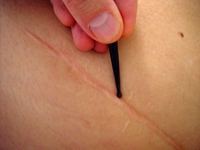
This is easiest with skin scars: scars that are causing a disturbance either make themselves felt spontaneously, for example when the weather changes, or they itch or are sensitive to pressure. You can examine the scars yourself by running a narrow, blunt object (e.g. the tip of a ballpoint pen with the refill retracted) along the length of the scar with light pressure. Compare the touch with the surrounding skin. If the scar is more sensitive or a cutting sensation arises, an irritation zone can be assumed.
It is remarkable that scars which cross the acupuncture meridians (caesarean section, operation on the womb through the lower abdomen, appendix) are more likely to cause a disturbance than those that run lengthwise (heart operations, abdominal operations with a midline incision).
How does neural therapy work?
A normal nerve cell has an electrical charge of about 90 millivolts at its outer membrane. Pathological changes lower the energy level, the nerve cell loses its stability and begins to send uncontrolled stimulus signals to its surroundings. Just as a jamming transmitter can interfere with the reception of a radio signal, the language of our nervous system is then perceived only as a croak, as with a poorly tuned medium-wave station.
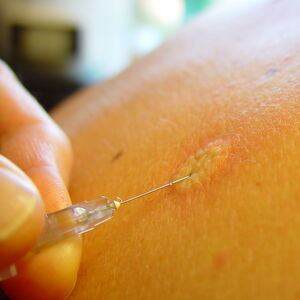
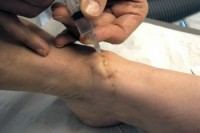
In neural therapy, a local anaesthetic (usually procaine or lidocaine) is injected in a targeted way, which switches off the disturbing nerves. This is done by means of wheals (small injections into the skin, see fig. left), small injections into scars (fig. right) or deeper injections.

This sets two processes in motion:
- The “jamming transmitter” is instantly switched off, partly or completely. The body is freed from the interfering signals, and the “language” rings out again in high, “digital” quality.
- As is familiar from a visit to the dentist, the local anaesthetic produces local anaesthesia. The area becomes numb. The nerve cell loses its (pathologically altered) electrical charge and is immobilised, like a broken bone in a plaster cast. Over the next few hours, for as long as the anaesthetic is working, the nerve cell has the opportunity to regenerate and to refill with energy. Once the anaesthesia has worn off, it builds up a healthy and stable electrical charge again. Once the responsible irritation zone has been identified and switched off by neural therapy, healing can occur within a short time, sometimes within seconds. This is then called the “seconds phenomenon according to Huneke”, named after the discoverer of neural therapy.
How is neural therapy used? The range of applications is very wide. Neural therapy can be used above all for long-lasting and constantly recurring illnesses, for example neuralgia, migraine, glaucoma, inflammation of the eyes, ear complaints, asthma, hay fever, nervous complaints, digestive problems, rheumatism, etc.
Because muscles work, in a certain sense, in a similar way to nerve cells, neural therapy can also be used for tension, in order to release muscle cramps.
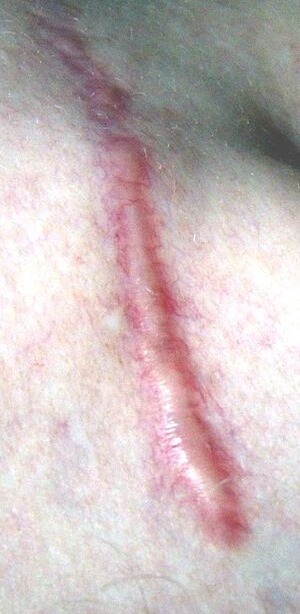
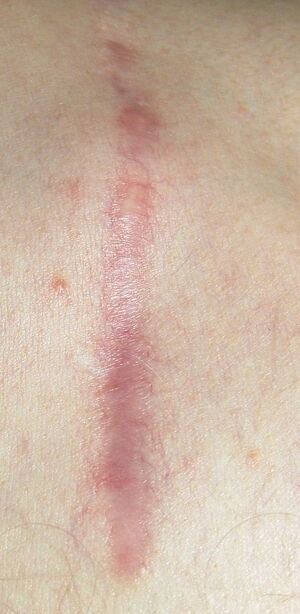
Neural therapy is also worthwhile for deep-lying scars, for example after an operation for a slipped disc. It is possible to relieve or cure remaining local or radiating complaints effectively by injecting into the scars. Interestingly, “ugly” scars become much less conspicuous again after neural therapy and are often no longer felt to be “foreign”.
Where is neural therapy ineffective?
Neural therapy can only work if the tissue is capable of regeneration. This is usually still the case when complaints are present but the doctor “finds nothing”. The patient can also often observe fluctuations in the course of the illness, up to and including being completely free of complaints. If, on the other hand, tissue has already been destroyed or an organ has been altered, as for example with gallstones or tumours, no substantial effect can as a rule be hoped for from neural therapy. Likewise, no effect is to be expected in mental illnesses, hereditary conditions, diseases of the brain, stiffened joints or advanced infectious diseases (sexually transmitted diseases, tuberculosis and other bacterial inflammations that require antibiotic therapy).
Promoting the body’s self-healing powers
When applied correctly, neural therapy is completely harmless, entirely tolerable and, for many complaints, one of the most effective methods of activating the body’s self-healing powers. It is often possible to bring about a recovery even in conditions regarded as incurable. Advice from a specialist will clarify the possibilities and limits of treatment in the individual case.
Left
The autonomic nervous system
Is it not wonderful that we can decide for ourselves when we get up in the morning, eat, drink, work, pursue our hobbies or simply laze about? On closer inspection, all these activities that we take for granted have a common denominator: the control of our muscles by our voluntary nervous system (WNS), but nothing more. What about the vital functions themselves? Imagine having to control your heartbeat or your breathing with your thoughts: any distraction could mean death. If bowel function depended on voluntary commands, the most massive digestive disorders would be inevitable. At the end of the day we would be completely exhausted merely from keeping ourselves alive, let alone from achieving anything “useful”. That this is not so we owe to our second “self”, which skilfully regulates the complex vital processes and keeps us alive without our having to make any voluntary contribution. This “self” is essentially the vegetative, involuntary or autonomic nervous system (ANS), which far exceeds our WNS in extent. The ANS makes our heart speed up on exertion and decides whether we also sweat while doing so, blush when we are ashamed and have our “hair stand on end” when we are afraid.
Sympathetic / parasympathetic nervous system
The ANS consists of two opposing players, the parasympathetic nervous system (PSNS) and the sympathetic nervous system (SNS). They ensure the harmony of our health, analogous to the yin and yang of Chinese medicine.
The SNS, corresponding to yang, stands for readiness to perform and for drive, whereas the PSNS (yin) stands for rest, recovery and digestion. How delicately the SNS cooperates with the PSNS may be illustrated anecdotally by the fact that “virility” is controlled by the PSNS and ejaculation by the SNS. Accordingly, and to their chagrin, men know best how prone to disturbance the ANS can be!
| Sympathetic nervous system | Parasympathetic nervous system | |
|---|---|---|
| Pumping capacity of the heart | + | - |
| Blood pressure | + | - |
| Heart rate | + | - |
| Breathing volume | + | - |
| Bronchi | Dilation | Constriction |
| Basal metabolic rate | + | - |
| Saliva | thick | thin |
| Urge to urinate | - | + |
| Bowel activity, bile | - | + |
| Pupils | Dilation | Constriction |
| Adrenaline | + | - |
| Eyelid opening | wide | narrow |
Dynamic network
The ANS is an all-embracing dynamic network that permeates the whole organism like a labyrinth and, taken as a whole, reaches practically every corner of our body, with the fibres ending in the connective tissue. This is also the place where the nerves release their highly active transmitter substances and from where impulses are sent back to the spinal cord and brain. In health, these signals are harmonious and able to compensate for disturbances. It can happen, however, that harmful influences, for example after an injury, an operation, a dental disease or an inflammation, do not simply subside and begin to take on a life of their own. The impulses are passed on permanently and disturb the function of the ANS; the SNS is activated (“stress” response) and the PSNS, as its opposing player, may be inhibited at the same time. In keeping with the enormous extent of the ANS, the most varied disorders of well-being and symptoms can result. In addition, in this sense any site in the organism can theoretically become an irritation zone.
The ANS is also responsible for the fact that in a heart attack pain radiates into the left hand and in biliary colic into the right shoulder, but also that bowel cramps are relieved with a hot-water bottle. These effects are mediated by nerve connections in and near the spinal cord. In addition, certain nerve fibres have an activating effect on the transmission of impulses and others an inhibiting one (“gate control”). Here, too, a delicate balance has to be maintained. Chronic interfering signals from the ANS are capable of throwing it out of balance. As a result, pain impulses, for example, could reach the brain unfiltered. Signals that do not normally enter consciousness are suddenly perceived as chronic, “inexplicable” and above all “unnecessary” states of pain. Neural therapy, the targeted injection of a local anaesthetic (procaine or lidocaine) at suspect zones or at nerve junctions (ganglia), is like restarting a computer that has frozen. The autonomic nerves then resume their normal function. The most common irritation zones are the tonsils, teeth, paranasal sinuses and scars.
The stellate ganglion
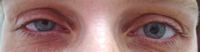
One of the most important nerve junctions in neural therapy is the stellate ganglion at the side of the neck. It controls the SNS in the upper quarter of the body, that is, the upper chest region, the arm and the half of the head on the same side. The influence on the SNS is demonstrated very nicely by the reaction of the eyes (see fig. and compare with the table). The SNS is temporarily switched off by the injection and the parasympathetic nervous system dominates, so that the eye on the side of the injection passes into a “twilight state”: the eyelid droops, the eye becomes slightly reddish and the pupil constricts.
Right eye after neural therapy of the stellate ganglion
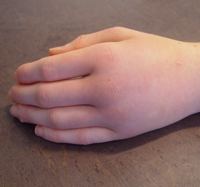
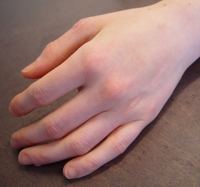
A very rewarding indication for injection at the stellate ganglion is Sudeck’s dystrophy, a feared complication after operations and accidents, especially of the upper limbs. A kind of inflammatory reaction sets in, and the body seems to want to reject the limb. This involuntary process also runs primarily via the ANS and can accordingly often be influenced by NTH. Mrs J.K., for instance, suffered from such pain and swelling of the left hand, which developed a few weeks after a burn. A few days after injection at the stellate ganglion, the swollen hand was already clearly slimmer and the pain had practically disappeared.
Further indications for NTH at the stellate ganglion are tinnitus, migraine, circulatory disorders in the arm (“dead fingers”) or head (stroke) and glaucoma. The prospect of success is always best the earlier the therapy is started.
A detective’s instinct
The use of neural therapy demands a detective’s instinct on the part of the doctor, and often patience on the part of the patient. The so-called seconds phenomena with immediate healing have become rarer than they used to be, possibly because of our many environmental, stress and dietary factors. It is to be hoped for everyone, however, that they do not have to wait as long for healing as a patient of my teacher Dr. med. Andreas Beck, Bern, who came to see him at the age of 93. At the age of 20, after shingles on the face, he developed treatment-resistant migraine and trigeminal attacks twice a week. After one (!) neural therapy injection into a scar the size of a grain of rice that had been left behind by the shingles, the complaints disappeared permanently after 73 years.
Patient experiences
R.B. has suffered from eczema on the buttocks for several years. Previous therapies without success. Sensitive operation scars from the appendix and the Achilles tendon. When the Achilles tendon scar is tested, the patient feels sick. After the scar’s irritation zone has been cleared, the eczema has disappeared.
B.R. has had diarrhoea after meals for decades. Bicycle accident in 1966 with extensive scarring on the lower legs, which is sensitive when tested. After neural therapy together with colon hydrotherapy (bowel irrigation), the diarrhoea has disappeared.
B.F. Residual pain in the hand after carpal tunnel surgery. Repeat operation planned. Neural therapy into the scar leads to freedom from complaints, and the operation is cancelled.
D.L. Chronic pain after a coccyx fracture, which endangers her profession as an organist. The planned surgical removal of the coccyx can be cancelled after a single deep neural therapy treatment in the sacrum. Free of complaints.
D.S. is losing an unusual amount of weight. Pressure in the stomach after eating, even with small portions. Recurrent nosebleeds. The irritation zone of a scar on the right lower leg is cleared by neural therapy. Since then he has been able to eat normal portions again. Weight gain at last and no more nosebleeds. Confirmed again after four years, still free of complaints.
J.H. suffers from pubertal obesity. Even on the strictest diet he does not lose weight. At the age of 11 he was operated on through the abdominal wall because of a testicular condition. After neural therapy into the scar he loses weight rapidly, although he is eating normally again.
Patient, 35 years old, gave birth to a healthy child by caesarean section 6 years ago. Family planning was not yet complete, yet the marriage remained sterile in the years that followed. On examination, the caesarean scar proved, through its heightened sensitivity, to be an irritation zone. After the irritation zone had been cleared by neural therapy, the patient became pregnant the very next month.
I am a level-headed lawyer of just under fifty, a director of an insurance company, and my father was a natural scientist. I describe myself as an atheist and believe in the modern sciences and the laws of nature. I sketch this background to make clear that nothing is further from me than a leaning towards the supernatural, esotericism or other charlatanry, but that I am perfectly able to accept facts proven by experiment.
At eighteen I had a motorcycle accident with a skull fracture and severe concussion; since then I was often plagued by headaches for long periods, but life was still bearable. At 24 I travelled through Central America, and it was there that, for the first time (during a speedboat trip at sea), the attack-like, extremely intense right-sided headaches occurred that were to shape my life from then on for a good twenty years.
At first I thought nothing of it; after the trip I went to a pharmacy, bought painkillers, and things improved. But soon the attacks recurred, and soon I was having them several times a week. The tablets visibly lost their effect.
After my return to Switzerland, my years-long odyssey began through the clinics and various doctors of Switzerland and later even in neighbouring countries. Countless examinations followed, EEG, X-ray, computed tomography, dental examinations and more, but the right-sided headache attacks returned, if anything with increasing regularity. After every visit to the doctor a prescription was pressed into my hand, and the painkillers helped for a short while each time. In time I felt like a walking poison cabinet and had blood in my stool because the gastrointestinal tract had been attacked by the tablets. An allergic reaction to one of these medicines put me in hospital for several weeks, healthy, fully developed wisdom teeth were pulled, and an artery in my head was surgically removed. Every specialist made his diagnosis and prescribed a therapy, all to no avail.
There followed consultations and treatments with acupuncturists and holistic examinations at specialised pain clinics, including a sleep-deprivation EEG and inhaling oxygen; a psychiatrist was also brought in. Later, when one was trying to clutch at every straw to be rid of the accursed attacks, there even followed (at my girlfriend’s wish, against my inner conviction) healers who lay on hands and pendulum dowsers. The pain attacks continued with varying frequency. During this time I also often thought of suicide, so severe was the pain each time.
Only a longer course of therapy with a chiropractor brought a noticeable improvement; for a while I was even almost free of pain, but after relapses the new treatments no longer worked properly, and a new ordeal of painkiller consumption began.
One day I was again complaining to my GP, Dr. med. John van Limburg Stirum, about the decreasing effectiveness of the painkillers when he suggested neural therapy to me. After he had described the procedure to me, I consented to the therapy despite mental reservations (after all, by his own account the therapy was not recognised by conventional medicine).
After only the second injection into the nerve in the neck, the frequency of the attacks fell to once a week, and the intensity decreased as well. After a few more injections the attacks disappeared completely, as suddenly as they had once come. About a year and a half ago a new, pain-free chapter of my life began, something I had hardly thought possible any more after suffering for so long