The lactate exercise analysis is carried out on a bicycle ergometer. During the ergometry, the activity of the heart can be recorded at the same time by electrocardiogram. In special cases, oxygen uptake is also measured (spiroergometry).
At the start and at certain exercise levels, a small capillary blood sample is taken. We need this to measure the lactate levels.
Depending on the starting value and the way in which it rises during exercise, conclusions can be drawn about the body’s energy balance and thus about the function of the mitochondria. In addition, depending on the shape of the curve, this test allows us both to define optimal training conditions and to show which supplements can be taken to improve performance.
Preparation
Come in sports clothing such as a tracksuit and trainers. Not fasting. You must not have done any sport earlier on the same day. In the case of a follow-up examination, you must have taken the prescribed micronutrients on the morning of the examination.
Here you can see various curve shapes and their meaning:
Where the curve begins to become steep is the so-called lactate threshold (grey dot on the blue curve). To the left of this dot on the blue curve, energy is generated above all by burning oxygen; to the right of the dot, energy production is above all oxygen-free.
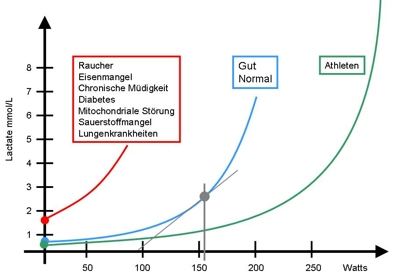
Untrained or sick people who show a result like the red curve in the figure obtain their energy above all without oxygen, and not particularly well at that. Accordingly, the curve also soon stops rising. Athletes, on the other hand, often show a curve like the green one in the figure. They can produce energy optimally both with and without oxygen, therefore have much greater endurance and can also deliver more performance (e.g. speed).
Sport
Training 3 to 4 times a week is recommended. By measuring lactate, the optimal aerobic training range can be determined individually. If it lies in the range of 1.5 to 2.5 mmol/L, the intensity of the exercise is perfect.
Different sports place different demands on our energy production.
| Immediately available energy | Intensive energy supply within minutes | Long-term energy supply | |
|---|---|---|---|
| ATP - PCr Share in % | Lactic acid Share in % | Oxygen Share in % | |
| Golf swing | 95 | 5 | 0 |
| Fencing | 90 | 10 | 0 |
| Tennis | 70 | 20 | 10 |
| Football | 50 | 20 | 30 |
| Skiing | 33 | 33 | 33 |
| Rowing | 20 | 30 | 50 |
| Marathon | 10 | 20 | 70 |
| Sprint | 40 | 55 | 5 |