Arteriosclerosis (calcification) of the abdominal aorta
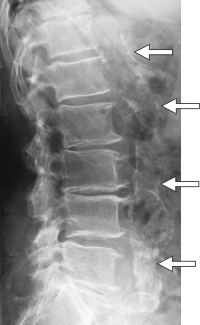
Chelation therapy is an outpatient treatment that is currently enjoying a real triumphal march through the USA. Many books and scientific publications document its outstanding results in arteriosclerosis and circulatory disorders. Among other things, the body is given a solution that contains various minerals and vitamins, but above all the active substance EDTA (see below). A similar compound also occurs in protein-rich foods.
EDTA has the property of binding heavy metals in the body, for example cadmium (cigarettes) and lead (petrol residues), as well as the light metal calcium, and excreting them via the kidneys. It is therefore outstandingly suitable both for metal poisoning and for the treatment of arteriosclerosis. The decisive point is that EDTA has a great binding capacity for the so-called transition metals, which can be helpers in the formation of excess free radicals. As a result, arteriosclerosis is halted, the cell functions are restored and the calcium overload is reduced. Calcium bound to protein is left untouched by EDTA. No decalcification of the bones occurs.
Chelation therapy is practised all over the world. In the USA, more than 1000 doctors have already specialised in it. Around 300,000 patients have so far received approx. 4,000,000 infusions.
The history of chelation therapy began in the 1930s at the company IG Farben in Germany, where a white, crystalline, water-soluble powder of ethylenediaminetetraacetic acid (EDTA) was developed as a colour stabiliser. A few decades later, the usefulness of this powder for medicine was also discovered. In the 1950s, an American doctor who suffered from very severe angina pectoris came upon the idea, in his mortal distress, of decalcifying his arteries with EDTA. This saved not only his own life but also the lives of many of his heart patients, whom he called in to be treated with his new method. In the years that followed, chelation therapy was used by a constantly growing number of doctors.
The effect of EDTA
- EDTA is a synthetic amino acid that is non-toxic to humans and has the ability to form complexes with metal ions (= “chelates”: from the Greek chele = claw), from which these cannot escape, like “prisoners in handcuffs”, and are transported out of the body (decorporated) with the urine. The first uses of chelation therapy were therefore in acute poisoning with the heavy metal ions lead, cadmium and mercury. Today it is known, in contrast to the knowledge of the chelation pioneers, that the effect of EDTA cannot be compared with a coffee machine descaler but is extraordinarily complex:
- EDTA increases the formation of parathyroid hormone in the parathyroid gland. This supports the removal of calcium from deposits in unphysiological places (arteries) and takes it to the places where it belongs (bones and teeth). This is the basis of the slight recalcification of osteoporotic bones under therapy with EDTA.
- EDTA acts as a potent antioxidant against the cell-damaging effect of the so-called free radicals by removing the corresponding excess catalysts (effect enhancers) copper and iron from the body.
- EDTA eliminates the heavy metals lead, mercury, cadmium and aluminium and thereby restores the proper function of the enzyme chains.
- EDTA stabilises the cell membranes.
- EDTA ensures balance in the prostaglandin hormone system and free blood flow to the individual organs.
- EDTA lowers the risk of the formation of a thrombus, which blocks the coronary arteries in a heart attack.
- EDTA increases the elasticity of tissues, improves skin tone and reduces the formation of wrinkles.
The scientific foundations
for today’s practice of chelation therapy were also provided by other branches of medicine such as nutritional science, orthomolecular medicine, enzyme therapy, cancer and rheumatism research, as well as the physiology and biochemistry of metabolism and of oxygen supply in chronic, degenerative diseases. All these research results led to the discovery that the common cause of the degenerative diseases and of the ageing processes is not only the heavy metals and the calcium and cholesterol waste deposits on which the first chelation therapists focused their attention, but that the roots of all these diseases lie “one storey” deeper, with the so-called free radicals. When everything works well, these supply, as “energetic projectiles”, the energy needed for metabolism; but as soon as their capture and transfer mechanisms are defective, they damage the body’s own tissue cells by “bombarding” its own cells right down to the chromosomes, which are responsible for cell division, and cause them to multiply in an uncontrolled way, which is the cause of all malignant tumours. Chelation therapy and the reduction of free radicals enable the damaged cells to recover slowly.
| Main indications | Secondary indications |
|---|---|
| Arteriosclerosis Angina pectoris Rheumatoid arthritis Diabetes Vascular occlusions Skin conditions Cardiac arrhythmias Detoxification for smokers | Alzheimer’s disease Eye conditions such as macular degeneration Frigidity and impotence Multiple sclerosis Kidney calcification Rheumatism Shoulder tendinitis Scleroderma |
Various study results
from: Altern. Med. Rev. 2007 Jun; 12(2):152-8
EDTA Cardiac Events Study: 220 patients with 3 years of follow-up
| Statistically predicted number | Actually occurred | |
|---|---|---|
| Heart attacks | 15 | 0 |
| Deaths | 6 | 0 |
| PTCAs during follow-up | 31 | 2 |
| CABG operations during follow-up | 16 | 6 |
Surgical or interventional procedures required in patients with primary PTCA and stent therapy during the 3-year follow-up
| Control groups | Patients treated with EDTA (25 patients) | |
|---|---|---|
| Re-PTCA | 22.3% | 4% |
| CABG operation required | 11.8% | 0% |
Thrombosis of drug-eluting stents with clopidogrel compared with EDTA
| EDTA | Long-term administration of clopidogrel | |
|---|---|---|
| FDA approval | No | No |
| Clinical studies | No | No |
| Platelet inhibition | 3 mechanisms | 1 mechanism |
| Risk of major bleeding | No | Yes |
| Preliminary clinical data showing efficacy | Yes | Yes |
Study by Dr. Thomas B. Fischer
- Thinning of the inner vessel wall after 30 chelation therapies
- IM T re / li = measurements before therapy
- re / li n. = measurements after therapy
- 0 = average values
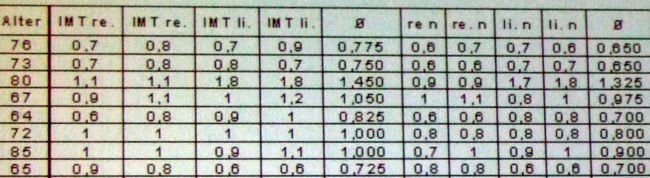
The results are highly significant.
Today’s chelation therapy, with its vitamin and mineral additives, has thus become not only a revolutionary causal therapy for chronic degenerative diseases that already exist but also, when used repeatedly as a preventive measure, a preventive therapy for the ageing processes and the complaints of old age as such, whose appearance it can postpone by years.
The insufficient spread of chelation therapy
and the medical profession’s lack of knowledge about this method can be explained by the fact that the patent for EDTA expired in 1948 and EDTA is not a lucrative product from a commercial point of view, so that the pharmaceutical companies are not motivated to advertise the unique effect of chelation therapy. Heart surgeons and specialists in conventional medicine also lack the motivation to learn this method, although they are obliged by law to inform the patient about the alternatives to a heart operation. According to statistics from the USA, up to 60% of bypass operations could be avoided by chelation therapy.
Costs
The costs of the therapy can be found in the current price list (under login) and include the regular urine and blood pressure checks and all additives (vitamins, trace elements and others) to the infusion. The price results above all from the duration of several hours and the monitoring of the infusion. The total costs thus depend on the severity of the illness and the corresponding number of infusions required.
Contraindications
The contraindications for treatment with the EDTA solution are insufficient kidney, liver and heart function, pregnancy and calcified zones of tuberculosis. As EDTA binds not only calcium but also essential trace elements and lowers the blood level of vitamins B and C, these must be added to the chelation infusion (substituted). For this reason, medical supervision before and during chelation therapy is necessary.
Side effects
Occasionally, slight pain, tiredness and a change in blood pressure or blood sugar level may occur during the infusion. They are controlled without difficulty by slowing the infusion rate. These accompanying symptoms usually disappear by themselves after 2 sessions.
As other minerals such as calcium, iron, manganese, molybdenum and zinc may also be excreted, these must be checked regularly (approx. every 10 infusions).
Preparation
A thorough medical examination (with blood and urine analyses), also periodically during the treatment, ensures optimal monitoring.
The treatment
A complete course of chelation therapy comprises a minimum of 20 to 30 individual infusions, a healthy diet and sufficient exercise. In advanced cases of arteriosclerosis and in arterial occlusion, considerably more sessions are necessary (30 to 100 infusions); as a basic rule, the number of infusions required corresponds to the patient’s age. The infusions are given 2 to 3 times a week and must be administered very slowly. A therapy session therefore takes at least 3 to 4 hours. A burning sensation during the therapy from the puncture site upwards means that the infusion rate must be reduced. To strengthen the effect of chelation therapy, additions of vitamins and trace elements and booster infusions at regular intervals are recommended.
Chelation therapy can also be used together with other forms of therapy for arterial occlusive diseases. It is entirely compatible with “blood thinners” and with medicines that dilate the blood vessels, lower blood pressure or act against cardiac arrhythmias. During or after successful chelation therapy, it is often possible to do without certain medicines in part or entirely. Chelation therapy is also possible after vascular surgery or amputations. The aim, however, is to use this therapy to prevent such serious interventions from the outset.
Left
Report from the EUROPÄISCHE ZEITUNG, March 2001
Not recognised by conventional medicine despite demonstrable successes
Chelation therapy slows “free radicals”
When the term chelation therapy is mentioned in medical circles, an extremely controversial discussion can be expected with certainty. This is because conventional doctors have always taken a critical view of new therapeutic principles and it takes a long time for the “new” to become socially acceptable.
The American sailors were actually only supposed to paint their warship. But this task had dangerous consequences: during their work, the seamen inhaled the toxic fumes of the lead-containing red lead paint. This was a decisive test for the new chelation therapy. With the help of a chelating agent, the so-called EDTA solution, the sailors’ lead poisoning was treated, and successfully in every case. That was not all: it was soon found that in some patients further complaints, above all anginal symptoms, also disappeared and that people’s general condition improved markedly.
That was in the 1950s. The positive effects of chelation therapy that had first been found in the sailors could later also be observed in a similar form in children who had scratched lead-containing wallpaper off the wall and put it in their mouths.
The binding capacity of EDTA (Ethylene-Diamine-Tetraacetic-Acid) for heavy metal ions was known. The substance itself dates from the 1930s, when it was used in the textile industry. The principle of chelate compounds goes back to the Swiss Nobel laureate of 1913, Alfred Werner.
It was first used in humans as early as the war years and afterwards, to treat radioactive contamination and nickel poisoning.
Between 1950 and 1966, chelation therapy experienced a “heyday” in the USA, although at that time, measured against today’s state of knowledge, there were still no clear ideas at all about the dosage and the infusion time. At the end of the 1960s, the rise of bypass operations began in the USA, and chelation therapy largely disappeared from the scene. In addition, there were some deaths under chelation therapy, which were published and understandably spread uncertainty.
These deaths, however, can clearly be attributed to errors in dosage and infusion time: from today’s point of view, about twelve times the amount of EDTA was administered at that time, and the duration of the infusion, today three and a half to four hours, was about half an hour. The patients developed a crash kidney and died of acute kidney failure.
All of this now lies more than 30 years in the past, and in the meantime there is absolute clarity about the correct dosage and duration of infusion. Nevertheless, these incidents are still cited today when it comes to discrediting and rejecting this therapy.
What is studiously overlooked, by contrast, is that according to reliable statistical data not only do around two to three per cent of patients die during or after bypass operations, but about 50 per cent of the bypasses close again after a few years. This information is not usually passed on to patients in the relevant information discussions.
The approach of a causal therapy
But what lies behind chelation therapy? And above all: how does it work? Every person has vessels in their body with a length of about 100,000 kilometres, including the capillaries. In a bypass operation, a stent or a balloon dilatation, the corresponding measures are carried out over a length of a few centimetres, and the “rest” remains untreated, so one can certainly speak of symptomatic measures. In chelation therapy, the infusion fluid (EDTA solution) is distributed throughout the entire vascular system: the approach to a causal therapy.
While the binding of heavy metal ions by the chelate in the course of chelation and their excretion (over 90 per cent via the kidneys) have long been known, until a few years ago there was still the idea that chelation therapy was a kind of “drain cleaner” for the calcified vessels. EDTA was thought to loosen the arteriosclerotic plaques, which would then be flushed out by the blood. This raised the obvious question of whether larger plaques might not then lead to infarctions.
Pharmacological investigations have shown, however, that the mechanism of action of chelation therapy is essentially to be seen in a minimisation of free radicals. These free radicals are recognised as one of the main causes of arteriosclerotic processes. The pathology of free radicals is a cornerstone of today’s knowledge about the mechanism of action of chelation therapy.
The main indication for this therapy is vascular disease caused by arteriosclerosis.
The following should be mentioned in particular:
- Intermittent claudication (“window-shopping disease”)
- CHD (coronary heart disease)
- Condition before recommended bypass operations (if not so acute that surgery must be performed immediately)
- Condition after bypass operations (to keep the vessels open permanently)
- Condition after apoplexies (strokes) and infarctions
- Arterial occlusions and stenoses in general
In addition, the elimination of heavy metal ions remains an important indication, and very often the amalgam burden can lead to considerable health problems.
Provided that the requirements of the therapy protocol issued by the DGCT (Deutsche Gesellschaft für Chelat-Therapie), which is structured in line with the therapy recommendations of the American ACAM, are followed in chelation therapy, experience shows that only minor side effects are to be expected. The most frequent side effects are burning at the puncture site, shivering (temporary), a fall in blood pressure and tiredness.
Of course, the positive “side effects” that can frequently be observed should not be disregarded either: lowering of total cholesterol, improvement of vascular tinnitus, improvement of vision, gradual lowering of blood pressure (reduction of antihypertensive medication), improvement of anginal complaints.
In general, patients with severe heart disease, with severe kidney and liver disease and, naturally as a matter of principle, pregnant women should not be treated with chelation therapy.
As chelation therapy, as already mentioned, is not yet recognised by conventional medicine, the costs are not reimbursed by the health insurers, which means that the patient has to pay for the therapy personally (exceptions in cases of heavy metal poisoning).
Chelation therapy is already being used preventively to an increasing extent, on the one hand out of fear of events that run in the family (apoplexies, infarctions), on the other hand as a contribution to securing future health, for greater resilience and thus also for stronger professional and private creativity.
Michael Brückner
Patient comments
Details of how I feel as a result of chelation therapy (16 treatments)
- My blood pressure has stabilised at the normal level, so that the blood pressure medication could be discontinued.
- Stabbing pains in the neck region have disappeared.
- I feel more energetic, more focused.
- Tightness and feelings of anxiety, above all at night and during physical exertion (rushing for the train), have disappeared.
So I am very grateful and happy about this good progress and would like to thank you warmly once again for everything.
Mrs R.J.
CT angiography check: in the area of the internal carotid artery (the artery in the neck), stenoses (narrowings) are no longer detectable on either side.
***
I now have 36 chelation infusions behind me and can report the following. I now often have to switch off my hearing aid because it is really too loud for me, so I hear better. Before the therapy I had the feeling that I needed stronger spectacle lenses. In the meantime I have new glasses with the same lenses for distance. Only for reading have they become a little stronger. So I see better. Now comes my greatest joy: my memory. I walk through the village again and greet people by name. I go down to the cellar and still know what I wanted to fetch. Before, it was often depressing. I am very, very grateful for this success.
M.M., aged 61, 3 October 2006
***
After only 5 treatments I felt an increase in circulation. Suddenly I could run better without developing angina pectoris. The night-time calf cramps have disappeared. Breathing is easier for me. The blood flow to my head is better too. My eyesight when reading has also improved. Disappearance of unpleasant symptoms of Lyme disease such as joint and nerve pain. My memory has improved and my joy in life has returned.
I.A., aged 65, 17 November 2006
***
Since the chelation therapy I feel warmer in general and can tolerate the cold much better.
U.S., aged 60
***
Chelation therapy has given me something like a second life. No more back pain, and my dizziness has disappeared completely. My general well-being has improved and my resilience has increased. My cardiac arrhythmias have almost disappeared.
H.B., aged 86
***


Recommended books