Effect of acid rain


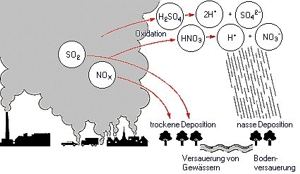
What is basically meant by acids and bases?
Chemical reactions can in principle proceed by two mechanisms:
- Transfer of electrons (outer atomic shell)
- Transfer of protons (atomic nucleus)
The latter is responsible for the acid/base reactions.
Definition: acids are substances that can release protons (positive charges) to their surroundings. Bases, for their part, are able to take up protons.
Water can react both as a base and as an acid:
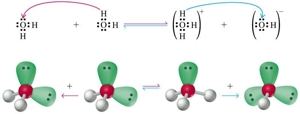
In water, some of the water molecules (H2O) react with one another and in this way produce, alongside H2O, H3O+ and OH- molecules as well. For every 10,000,000 water molecules we find one acidic water molecule and one alkaline water molecule. In this state we speak of a neutral water pH or a pH of 7 (10,000,000 has 7 zeros / the so-called logarithm). To simplify the relationship, the acid/base state is defined by the term “pH” (p = potential, H = hydronium ion = proton). The pH value is confusing in that the higher the proton concentration in a solution, the more acidic it is but the lower the pH value. Accordingly, a solution with pH 5 is 100 times more acidic than a solution with pH 7.
The pH scale ranges from 1 (strongly acidic) through 7 (neutral) to a maximum of 14 (strongly alkaline). Trace elements and minerals also have acidic and alkaline properties.
Acidic
- Chlorine
- Sulphur
- Phosphorus
- Fluorine
- Iodine
Alkaline
- Calcium
- Sodium
- Magnesium
- Copper
- Iron
- Manganese
The pH of the blood is ideally 7.35 to 7.45. In illness it can fluctuate between 7.0 and 7.8; beyond that it is no longer compatible with life.
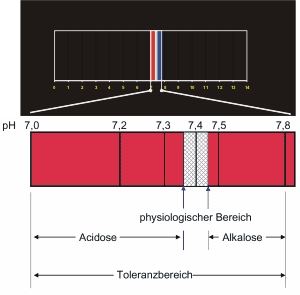
Because of this immense importance, the organism has multiple mechanisms for keeping this pH value stable. These “buffer systems” are made up of a wide variety of alkaline substances. These are above all
- Phosphates
- Proteins
- The blood pigment haemoglobin
- The base of carbonic acid, known as bicarbonate.
The latter is the most important buffer unit for us.
If these systems are intact, the buffer capacity is high and able to neutralise acid attacks. Otherwise the result is shifts in the pH value with corresponding strain on the metabolism, since most chemical and enzymatic reactions are strictly pH-dependent.
Acid-base processes are involved in practically all reactions in the human organism. In addition, the enzymes that make the chemical reactions possible in the first place are strictly dependent in their action on the pH of their surroundings. Accordingly, many diseases can be accompanied by disturbances of the acid-base balance:
- Allergies, eczema
- Angina pectoris, heart attack, arrhythmias
- Blood cancer
- Chronic fatigue
- Fever
- Hair loss
- Caries, dental disorders
- Poor concentration
- Cirrhosis of the liver
- Gastrointestinal disorders, heartburn
- Migräne
- Renal insufficiency
- Osteoporosis
- Psychoses, neuroses
- Rheumatic diseases
- Tumour diseases
- Burns
- Diabetes
Causes
Over-acidification (= acidosis)
Many metabolic reactions produce acids. However, we must distinguish between “good” and “bad” acids. A good acid is carbonic acid, which the body excretes without great effort via the lungs by breathing out carbon dioxide. In the process the carbonic acid turns back into harmless water. The bad ones are so-called organic and inorganic acids, which are “heavier” and “more sluggish” and therefore require a greater metabolic effort to be excreted.
Sources of bad acids
- Excess protein in the diet
- Hunger, fasting
- Medication
- Insufficient oxygen supply
- Poisoning
The opposite, alkalinisation, is also not uncommon:
- Diarrhoea
- Vomiting
- Low fluid intake
- Medication
Diagnostic methods

Unfortunately, pH measurement of the urine is very widespread. Since the kidneys are there to excrete acids, by producing acidic urine they are merely doing their duty. If the urine is alkaline, it may be that the kidneys are diseased and unable to acidify the urine accordingly. The body becomes acidic, the urine remains alkaline. For this reason pH measurement of the urine is useless and must not tempt anyone into taking alkalising preparations.
The best impression of the acid-base balance is obtained by analysis of a blood sample. Hydrochloric acid is added drop by drop to the freshly drawn blood and plasma and the pH is measured continuously (so-called titration). The lower the initial pH value and the more rapid the fall in pH, the more acidic.
Therapy
The best deacidification is achieved by optimising the metabolism. That means better circulation and use of oxygen. There are several ways of doing this. Most significant are personal lifestyle habits. These include
- Exercise
- Nutrition
- Rest.
Nutrition
80% of the diet should be alkaline, only 20% acidic.
Acid-forming foods
Meat, poultry, game, sausage, bacon, offal (liver, kidneys, brain), meat stock, butter, cheese, quark, eggs (egg white has an acid excess, the yolk alone is alkaline), peanuts, wholegrain cereals, cola drinks.
Alkali-forming foods
Potato, leafy vegetables, root vegetables, fruit vegetables, vegetable soups, fruit, including dried fruit, almonds, wild herbs, dandelion, stinging nettle, culinary herbs, cress, parsley, chives, marjoram, thyme, rosemary, sage, still mineral water.
Foods in acid-base equilibrium
Water, natural unrefined fats and oils
Further measures

If the acid load is high, additional measures can be taken, e.g. taking alkaline powders or even alkaline infusions.
For external use, alkaline baths (100 g sodium bicarbonate in a full bath, duration 30 to 45 min.) and alkaline thermal baths are popular.
The benefit of sauna visits for the organism is generally known. Intensive deacidification takes place during colon hydrotherapy.
Regular fitness training, at least 3 times a week, as far as possible in the aerobic range, where acidification is minimal. In addition, you must also allow yourself rest breaks (in modern terms: “power napping”).
Literature
- Moderne Säurebasen-Medizin, Dr. med. John van Limburg Stirum (available at the practice)
- Säure-Basen-Haushalt, Dr. med. Michael Worlitschek, Haug Verlag
- Säure-Basen-Einkaufsführer, Dr. med. M. Worlitschek, Peter Mayr, Haug Verlag
Acidic urine does not mean that you are acidic.
Many people check their urine using pH strips. Whenever these show a low pH value, they reach for the alkaline powder until the urine shows an alkaline value again.
Careful! The task of the kidneys is to excrete acid, which is of course constantly being formed in our metabolism. So if the urine is acidic, this is merely proof that the kidneys are doing their job! There are even situations, above all when one drinks too little, in which the urine is very acidic and one is nevertheless suffering from an alkalosis (the opposite of over-acidification!). Alkaloses are more common than one thinks!
So: we are not all over-acidified.
A precise assessment of the acid-base status is provided solely by the acid-base analysis according to Jörgensen, in which a venous blood sample is tested by adding hydrochloric acid.