The term diagnosis comes from “Dia Gnosis” and means “to recognise through and through”. Correct diagnoses, as in emergency surgery or acute medicine, testify to medical skill and can save lives. But what is the value of a diagnosis if it means no cure but merely an observation of states. This is the case with most chronic illnesses. Should a new term not be introduced here, the agnosis, or the failure to recognise? Agnoses have lost their precision and their usual therapeutic consequences. Once the agnosis has “anchored” itself, the illness is hardly questioned any more. As Manfred Porkert pointedly put it, such diagnoses are “stop signs of thinking”. The consequence is the entry into symptomatic treatment (pure prescription practice), through to the declaration of psychosomatic components. Further therapeutic possibilities are thereby thwarted, and the view of things is clouded rather than illuminated. If diagnosis means hope, the more numerous agnoses are joined by fear and a loss of quality of life. This situation will only further harm health and the immune system. A vicious circle? If there is no clear guidance here, the independent, desperate search for promises of a cure begins, which today is also made alarmingly easy by entering one’s “diagnosis” on the internet. Instead of the hoped-for therapeutic revelations, the person without medical training meets with confusion, disappointment and resignation. Moreover, the chronically ill feel the need to share their suffering (= diagnosis) with others. This solidarity can console on the one hand; on the other, reports of other people’s fates can drive someone into hopelessness and even to suicide.
Precisely in the chronic illnesses, where patients need the most attention, the agnosis brings about just the opposite. The agnosis moreover ignores our biological uniqueness and individual past, although the longer an illness has lasted, the more they shape one another. These are complex processes that must be treated in just as varied a way. In a medicine that takes the infinite complexity of our existence into account, the diagnosis loses its right to exist. In its place comes the need to record those affected, in their whole personality and individual past, as meticulously as possible. The point here is not to make a diagnosis but to remove as many burdening factors as possible. And with a little luck the body will again be enabled, by ways that will remain hidden from us and from our methods of measurement, to change the situation in its favour once more, in the sense of help towards self-help.
Agnoses that serve only to accompany a person for life and to be treated symptomatically should therefore ring in, rather than resignation, the inner mandate:
Never give up on yourself, despite your “diagnosis”.
Vitaswiss, magazine “Bisch Zwäg” 2004 Dr. med. John van Limburg Stirum
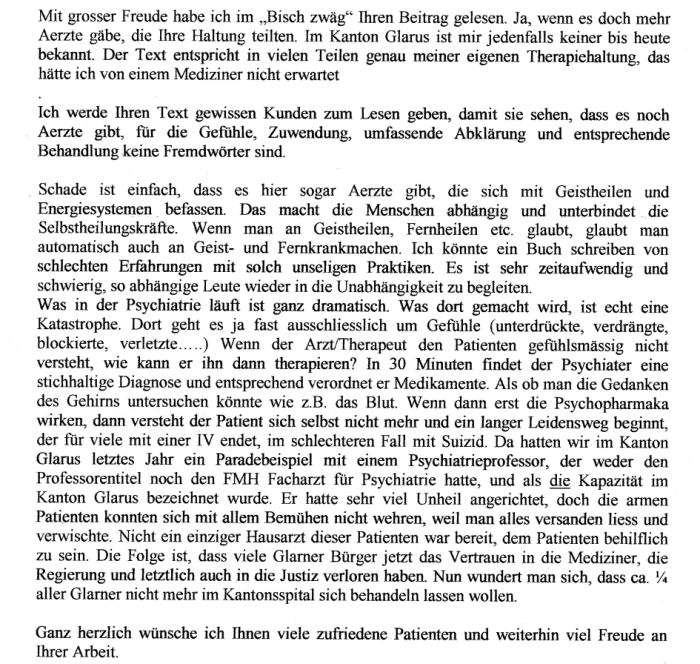
Reader’s letter