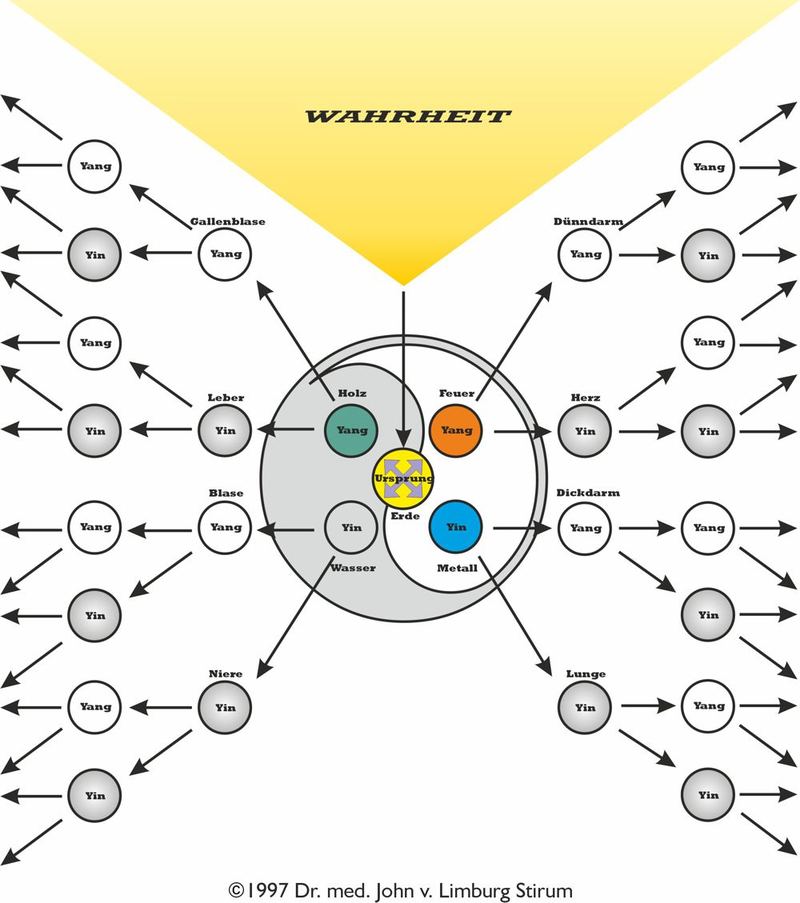
To understand acupuncture even in the broadest outline, we must detach ourselves practically completely from the familiar models of “modern medicine”; otherwise acupuncture will always resound in mystical, occult spheres and lose the high recognition it deserves.
Traditional Chinese Medicine (TCM) is a coherent and independent system of thought and practice that has been developed over two millennia. It is rooted in the philosophy and logic, the sensibility and the customs of a civilisation that is entirely foreign to ours, and it therefore has its own conception of body, health and illness. Analogous to this is the completely different approach to the human being and his ailments. The Western physician will ask about the symptoms and try to find a precise single cause for this particular illness, even if several parts of the body are affected. This is referred to as the “causal analytical” way of thinking: “X causes Y”. This foundation of Western thought was formulated by Aristotle (384-322 BC): “People do not believe that they know a thing before they have grasped its why”.
The Chinese physician, for his part, knows no individual organs as Western medicine does, and yet he is able to treat the corresponding illnesses. How does he do this? He directs his attention to the entire physiological and psychological individual. All relevant information is gathered and assembled into a vivid picture of the sick person until a “pattern of disharmony” becomes recognisable, which describes an imbalance in the body. The primary question is therefore “What is the relationship of X to Y?” There is no need to look for a cause.
Lao Tse
The Way created unity. Unity created duality. Duality created trinity. Trinity created the ten thousand beings. The ten thousand beings carry the dark Yin on their backs, the bright Yang in their arms. The breath of the Void makes their harmony
This kind of logic is called “inductive synthetic”. Describing disharmonies presupposes a comparing system that is capable of recognising a change in relation to the whole. This kind of logic created the Yin/Yang theory. It forms the basis of TCM and rests on the idea that everything in the world is polar. Cold cannot exist without warmth. The same applies to light and darkness, rest and movement, male and female, protecting and destroying, or matter and energy. This polarity, Yin (matter) and Yang (energy), is first found in the “Book of Changes” (Yi Jing), which was written around 700 BC.
A few hundred years later the Chinese Tao symbol familiar to us was created. The structures, which look like curved drops, flow into one another, emerge from one another, control one another and are themselves contained in the other. Eternal transformation is the result. Anyone who builds a house must put “energy” into it. When it is finished, nothing can be seen any more of the activity that was necessary to erect the building, but it is contained there in the walls.
The universe is in constant change, movement as the result of an inner dynamic, just like the four seasons. Nobody would claim that spring is a consequence of winter. Rather, they flow into one another, and this cycle repeats itself eternally. Embedded in these climatic changes through their evolutionary history, all biological organisms analogously also pass through the four seasons: birth, maturity, decline, death. Thus four so-called “phases of transformation” (WP) arose. Together with the Earth as the “centre”, they became five. They represent a further basic principle of TCM (cf. table on the next page). the body as an image of the constitution of nature.
This comparative relationship with nature also led to illnesses being seen as interactions of the human being with climatic influences: stormy weather as a source of disharmony. These “pernicious influences” are six in number: wind, cold, fire, heat, dampness, dryness and summer heat.
However, the body is only susceptible to the harmful effect of these natural events when Yin and Yang are out of balance or weakened. Only then does wind, for example, penetrate the organism (first the surface; later, through incorrect or absent therapy, it can advance into the depths) and cause a wind illness (note: the disturbance is wind and the illness is wind, cause = effect!). In Western language this would be, for example, rheumatism (after a draught!), but also infectious diseases, since germs are carried by the wind. Even accidents are wind phenomena, since they too are based on movement. TCM works with a wealth of correspondences; thus wind is also associated with spring, when it occurs most. Since it embodies movement and our musculature is likewise responsible for our movement, the musculature also belongs to spring or the phase of transformation “Wood”, for that is the time when nature begins to grow (movement!). To the same phase of transformation belongs the character trait of the choleric person, who can flare up and, as it were, lash out. And just as our everyday speech has it that “a louse has crawled across his liver”, so the liver likewise belongs to this phase of transformation. Accordingly, it is also the most sensitive to wind influences (same phase of transformation). Similar considerations can be made for all the other WP.
| Wood | Fire | Earth | Metal | Water | |
|---|---|---|---|---|---|
| Season | Spring | Summer | Late summer | Autumn | Winter |
| Yin organ | Liver | Heart | Spleen | Lung | Kidney |
| Yang organ | Gallbladder | Small intestine | Stomach | Large intestine | Bladder |
| Climate | windy | hot | damp | dry | cold |
| Emotion | Anger | Joy | Worry | Grief | Fear |
| Taste | sour | bitter | sweet | pungent | salty |
| Sense organ | Eye | Tongue | Mouth | Nose | Ears |
| Tissue | Muscles | Blood vessels | Connective tissue | Skin | Bones |
| Colour | green | red | yellow | white | black |
| Direction | East | South | Centre | West | North |
The WP consist of an outer and an inner energy system, which are connected to one another. Therapeutically important for us is the outer system, which is built up from the acupuncture meridians familiar to us. These channels are lines that arise from mentally connecting the acupuncture points (AP). The channels represent conduits in which the energy (“Qi”, pronounced chee) and the blood (“Xue”, pron. shweh) are transported, and they are in no way comparable with the Western notion of blood vessels. Thus, by manipulating these points (by needling, moxibustion (warming), or acupressure, laser puncture etc.), Qi and Xue can be influenced directly. The AP also have individual relationships to the phases of transformation and thus also to the organs, and show different qualities, such as distributing, gathering, dampening, stimulating, etc. The art of body acupuncture (KAP) is to develop, for every disharmony (for us, illness), a strategy with this wealth of AP and to deploy them like chess pieces for the good of our health. However, just as a chess player can be defeated by his enemy, acupuncture need not take effect straight away. Under certain circumstances a different strategy is required. It is therefore premature to call acupuncture as such into question after unsuccessful acupuncture sessions, just as we would hardly doubt antibiotic therapy if it should fail to help on one occasion.
How can the body become susceptible to the above-mentioned pernicious influences? The main causes are unbalanced emotions, incorrect diet, sexual excesses, physical overexertion and “wrong therapies”. These factors should be addressed first, before an illness breaks out. Nei Jing says in a poetic manner:
“To apply medicine after an illness has begun,..… that is like digging a well only after one has become thirsty, or forging weapons only when the battle has already begun.”
Here it is always a matter of balance, rhythm and harmony. Food should be prepared and eaten in a balanced way: green leafy vegetables (a Yin substance) are cooked with ginger (a Yang substance). Special physical exercises (T'ai-Chi) promote rhythmic and controlled movement.
Diagnosis in TCM rests on 4 pillars: observing, questioning, palpating, listening and smelling, the first three being the most important. Foremost are pulse and tongue diagnosis, where the energetic processes become visible and palpable. The aim and art of the examination is ultimately to grasp and interpret the human being as a living painting, similar to the work of an art critic, in order to derive the individual therapy from it.
A course of acupuncture therapy generally consists of approx. 10 sessions lasting up to 30 minutes. Only disposable needles are used, in order to make the transmission of diseases impossible. The success of the treatment does not depend on the number of needles inserted. In view of what has been said above, however, the patient must be asked to report all changes and reactions to the physician, so that the therapy can be adapted to the new situation if necessary. As a “side effect”, a blood vessel may occasionally be pricked, which can result in a small bruise, but is completely harmless.
Just as nutrition is regarded as a remedy, Chinese herbal medicine is almost more important for TCM than acupuncture, since the latter can merely redirect and drain off the existing energy, but cannot supply any. In addition, KAP takes place at the surface of the body, while the medicinal herbs, by being ingested, penetrate directly into the depths. They also have different temperature qualities (hot, warm, neutral, cool, cold), taste qualities (bitter, sweet, pungent, salty, sour, bland) and relationships to the phases of transformation. A combination of effects can thus be achieved in a targeted way through an appropriate composition. Peppermint tea cools the body, even when it is drunk hot! At the same time it relates to the WP Metal or to the lung. So where there is too much “heat in the lung” (bronchitis with purulent sputum), we can use it to cool this disharmony successfully and support recovery.
Foundation of Chinese philosophy