The circulation of the legs is based on a complex interplay of the arteries, veins, lymph vessels and muscles. The oxygen-poor, used blood has to be conveyed back to the heart through the venous system against gravity. To make this task easier, the veins have valves which, like non-return valves, prevent the blood from flowing back. In this way the blood is literally pumped back through the veins that are compressed by the muscles when walking (“deep veins”) (the “peripheral heart” of the body). That is why walking is healthy and standing is bad.
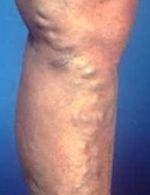
The superficial veins, which become apparent as varicose veins when they dilate, do not have this protective sheath of muscle. Although venous valves are found here too, they therefore tend to be widened by the weight of the blood lying above them. This prevents the valves from closing intact, so that the blood can flow back in the opposite direction. A vicious circle has arisen. In the end the blood flows downwards through the superficial veins instead of upwards. The skin is thus supplied with more oxygen-poor blood, which results in leg ulcers and poorly healing wounds. Likewise, the deep venous system has to cope not only with the normal blood but also with the blood flowing back, which in the long run can lead to overload (calf cramps, swelling, heavy legs).
Timely sclerotherapy or vein surgery can effectively prevent this and at the same time represents one of the most important medical indications for their treatment. The small varicose veins and the bothersome networks of spider veins, by contrast, are medically insignificant but occupy an important place cosmetically. While the large, thick varicose veins should rather be left to the surgeon, the small and medium-calibre ones are the domain of sclerotherapy (= sclerosing). Women suffer from varicose veins approx. twice as often as men.
Sclerotherapy of the veins
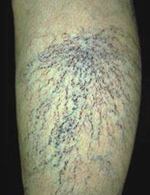
A sclerosing agent is introduced into the vein in order to produce an artificial inflammation of its walls. Some of these agents contain iodine, which is why we must be told of an iodine allergy without fail. The smaller veins are injected directly; from the large ones the blood is first drained. The bleeding stops once the leg is raised. The vein is now empty and collapsed. The sclerosing agent, now injected, can take effect at full concentration.
The compression bandage
After that, the leg has to be bandaged well so that the irritated vein walls are pressed together and can thus stick together. As a rule several bandages are needed for this. A small self-adhesive bandage over the sclerotherapy site must be left in place until the evening of the following day. Caution: above all near the ankle and knee joints, the skin under the bandage can become irritated and chafed (due to movement). Should pain occur, you must remove the bandage and take a look. The elastic bandages must be removed in the evening before going to sleep and put on tightly again in the morning. The technique of bandaging has to be learnt! Make sure you are instructed well. If the toes turn blue, this does not mean that the compression is too tight. Only when pain or cramps occur should the bandage be loosened. After removing the bandages and before putting them on, the vein gel prescribed for you must be rubbed in at the puncture site. In the course of the treatment, small lumps - clotted blood between the vein ends that have stuck together - may form at the sclerotherapy site. As a rule they disappear after months but, depending on their size and painfulness, can be punctured and squeezed out.
To achieve optimal results, the legs should be bandaged for at least four weeks after the last sclerotherapy injection.
The compression bandage is to be put on in the morning immediately after getting up. Do not walk around first, otherwise the decongestion of the leg that has taken place during the night is undone again. For effective decongestion the legs should, if possible, be elevated at night. However, the hollows of the knees must not sag in the process. So raise the bed at the foot end; a wedge pillow at the foot end is not enough.
- To put on the bandage, the foot, supported on the edge of a chair, must always be placed at a right angle
- Depending on the size and circumference of the leg, bandages 8 cm or 10 cm wide are best suited for compression bandages on the lower leg.
- Take the bandage in your hand so that the rolled-up part of the bandage lies on top and points outwards. Only in this way can the bandage be unrolled on the leg.
- When putting it on, unroll the bandage directly on the skin and pull both edges evenly in the direction of unrolling. Never pull away from the leg, otherwise the two edges of the bandage are tensioned unevenly and strangulating constriction furrows arise.
- The pressure exerted by the bandage must be strongest in the ankle region and decrease slowly towards the knee. Too much pressure in the calf area causes dangerous congestion. So pull the bandage tighter at the ankle and then ease off slowly, in keeping with the shape of the leg.
- You can check that the pressure is right by the fact that the toes first turn slightly bluish when the bandage is put on, but take on their natural skin colour again when walking.
- The foot area from the base joint of the toes and the heel are always bandaged, so that all congestion can only be pressed upwards.
- As a general rule, bandage dressings hold better and longer if you put a second bandage over the first one in the opposite direction of unrolling.
Sclerotherapy of varices is generally contraindicated in patients confined to bed, in arterial occlusive disease, deep vein thrombosis, diabetes mellitus, nephritis, active tuberculosis and other febrile or purulent infections, acute severe heart disease, all diseases and situations associated with restricted mobility (e.g. advanced age), and in all patients in whom compression therapy is contraindicated. Leg oedema is to be decongested by compression therapy before sclerosing.
SUMMARY
| Sclerotherapy | Operation |
|---|---|
| cheaper no hospitalisation / anaesthesia no time off work can / must as a rule be repeated at certain intervals (years) | good if afraid of injections better long-term results leaves scars |
| RISKS | |
| allergic reactions (rare) extensive inflammation of the veins permanent skin marks due to injection of the sclerosing agent next to the vein (hardly possible with correct technique) | deep vein thromboses (extremely rare) nerve injuries bruising injuries to main blood vessels infections |
Additional vein therapy
- Exercise! Walk longer distances (more than 7 steps!)
- Weight reduction
- Elevate the feet
- Avoid intensive exposure to sun and heat
- Shower the legs with cold water
- Compression treatment (support stockings etc.)
- Horse chestnut preparations to be taken orally