Ozone in medicine
The medical use of ozone (O3) was discovered over 150 years ago. In the 19th century, the recognised scientists and inventors Werner von Siemens and Nikola Tesla did pioneering work on the first ozone generators for medical purposes. During the First World War, ozone was used on a large scale to treat rampant infections. Later, the medical use of ozone became widespread in Germany and other countries. In the last ten years, the number of clinical studies has increased dramatically, which has led to a better understanding of ozone therapy.
As a strong oxidant, ozone induces antioxidant counter-reactions with a broad spectrum of concentration-dependent and dose-dependent effects that can be used for medical purposes. A considerable number of randomised clinical studies support the growing acceptance of ozone therapy for a range of indications.
Ozone as a medicine

Medical ozone, a mixture of pure ozone and oxygen, can be used both externally and internally. It has a strong inactivating effect on bacteria, fungi and viruses.
Medical ozone has a very pronounced bactericidal, fungicidal and virus-inactivating effect and therefore has a broad range of application in the disinfection of infected wounds, but also in diseases caused by bacteria and viruses. Its circulation-promoting property is used in the treatment of circulatory disorders and for revitalisation. In the low-dose concentration range, the body’s own defences are mobilised, i.e. the immune system is activated.
Most important applications
- Diabetes, diabetic foot
- Circulatory disorders
- Infections caused by bacteria and viruses
- Immunostimulating
- Cancer, support during therapy
- Macular degeneration
- Prostate conditions
- Regeneration
- Wounds, poorly healing
The specific properties of medical ozone give rise to the following areas of application in ozone therapy:
- Circulatory disorders, also in the field of geriatrics
- Stressed immune system, infections
- Diseases caused by viruses, such as liver diseases (hepatitis) and herpes
- Infected, poorly healing wounds and inflammatory processes, such as leg ulcers (ulcus cruris), inflammatory bowel diseases (colitis, proctitis), burns and infected injuries, fungal infestation etc.
- As an adjunct in rheumatic, inflammatory joint diseases
- Revitalisation
Forms of application
At Seegarten Klinik, therapies with medical ozone have been carried out for decades:
- Conventional ozone treatment (blood is taken once and returned with an ozone concentration appropriate to the indication)
- Ozone bag gassing (e.g. poorly healing wounds)
- Intestinal insufflation (for inflammation, microbial imbalance, poorly healing wounds, haemorrhoids and many other diseases of the colon and rectum)
The forms of application in detail
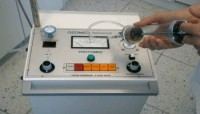
- The major autologous blood therapy in geriatrics and for the treatment of circulatory disorders as well as in diseases caused by viruses. 50 to 100 ml of the patient’s own blood are enriched with ozone and given back as a drip infusion.
- The minor autologous blood therapy is given as an intramuscular injection of the patient’s own blood for immune activation and is used for revitalisation, for the treatment of allergic diseases or generally to improve the body’s own defence.
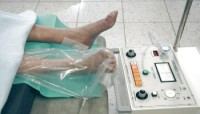
- The external treatment of wounds with the ozone-resistant plastic boot, bag or, for smaller wounds, a plastic bell. (See figure on the left)
- The rectal administration of ozone in inflammatory bowel diseases, but also for revitalisation and in diseases caused by viruses.
- The injection into joints (intra-articular) is carried out in orthopaedics for the relevant diseases.
- The injections into the arterial bloodstream (intra-arterial) are indicated in massive peripheral circulatory disorders.
Procedure and costs
Ozone therapy is a low-risk therapy and is often also carried out as a supplementary measure to other types of treatment. As a rule, a series of approx. 6 to 10 treatments is needed. Depending on the response, once a month thereafter.
Before ozone therapy, you should tell your doctor whether you are taking any medicines at that time and, if so, which ones. These medicines must on no account be discontinued without consulting the doctor.
It may be covered by the supplementary insurance for complementary medicine.
High-dose ozone therapy according to Dr. Lahodny (OHT)
What is different about high-dose ozone therapy?
By extremely increasing the concentration and dose of ozone, an improvement in the success of therapy is achieved that has not been reached before.
Procedure
The patient should drink approx. 0.75 litres of water or tea beforehand.
The blood taken from the arm vein is drawn into a sterile vacuum bottle. There, ozone is added to the blood.
The blood enriched with ozone then flows back into the body via the arm vein. This process is repeated 6 to 10 times. In one session, 1.5 to 2.0 l of blood are processed.
An OHT takes about 2 hours, depending on the quality of the patient’s veins.
As the standard procedure, one high-dose ozone therapy per week for a total of 10 weeks is recommended.
Contraindications
Acute heart attack, acute stroke, acute anaemia, blood clotting disorders. No treatment should be carried out during menstruation.
Effects
- Detoxifying effect
- Enzyme activation
- Improvement of circulation
- Activation of the immune system
See: https://de.wikipedia.org/wiki/Johann_Lahodny