In ageing people, the most important chronic diseases are limited to a few underlying conditions. Of these, the arteriosclerotic changes that calcify the vessels come first. The fact that ever younger people are affected, however, also depends on our modern way of life. Risk factors: smoking, no natural, unprocessed foods with a lack of vitamins and trace elements, overweight, lack of exercise and stress. Here the much-cited cholesterol plays a subordinate role. Until now it has tended to distract from the more important causes of arteriosclerosis and has thus done the prognoses more harm than good. Thus raised cholesterol was found in only 35% of heart patients. The non-cardiovascular deaths among men and women have tended to increase with the reduction of cholesterol. Digestive disorders and tumours occurred in particular. In women there is in fact no scientific evidence at all that cholesterol actually plays any role in vascular damage, since the studies to date included only men. An uncritical transfer of the data to women is not legitimate. It is therefore time to seriously question the old dogma of the cholesterol hypothesis. In the search for other risk factors, homocysteine, a toxic amino acid, was first discovered at the end of the 1980s (amino acids are needed for protein production, in which homocysteine is an intermediate product). In the relatively rare enzyme deficiency diseases in which this amino acid accumulates, those affected die at a young age of pronounced arteriosclerosis and thromboses. This “homocysteinaemia” is, however, also encountered relatively frequently in a milder form. We find genetic conditions in 1 in 70 (!) people. Even more often the cause lies in a vitamin deficiency (folic acid, vitamin B6, B12, choline, riboflavin) due to poor nutrition, alcohol, smoking, in insufficient absorption (permeability) through the small intestine, in anorexia, radiation, chemotherapy or other medication. The latter are above all gastric acid blockers, anti-epileptic drugs, antidepressants, the contraceptive pill and others. It can be assumed that such serious, widespread chronic diseases as cataracts, osteoporosis, impaired brain performance, ageing skin, rheumatism etc. coincide with raised homocysteine levels. It is interesting that in people with Down syndrome heart attack, stroke or circulatory disorders are as good as unknown. Responsible for this is the surplus chromosome present here, which prevents homocysteine from rising.
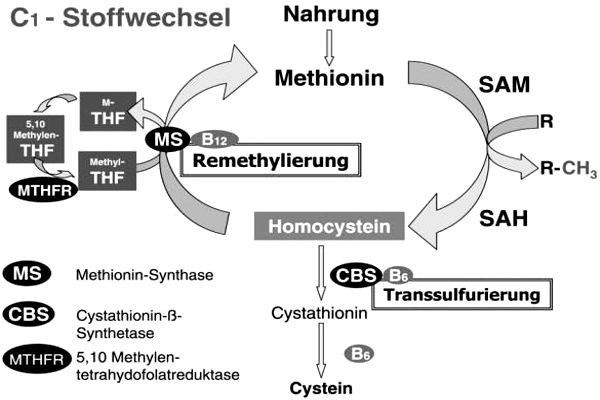
Biochemistry of homocysteine metabolism
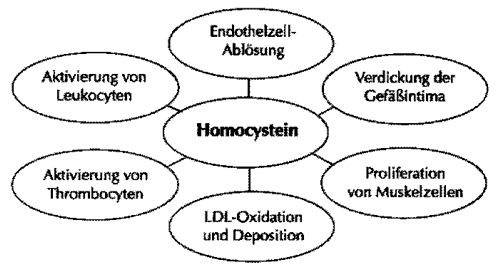
Mechanism of arteriosclerosis
Homocysteine can be oxidised (become “rancid”) relatively easily, releasing hydrogen peroxide, which attacks the vessel walls directly and causes certain lipoproteins to become rancid as well. As homocysteine rises, blood clotting is promoted, so that the risk of thrombosis increases further. Only after homocysteine has caused primary damage to the vessel walls can cholesterol be deposited. Cholesterol therefore plays a subordinate role in the development of vascular diseases! People with kidney disease likewise suffer more often from vascular complications. This is explained by the fact that the kidneys are no longer able to excrete homocysteine. This also happens in diabetes.
Treatment
The precursor amino acids of homocysteine should be avoided as far as possible. These include methionine-rich foods such as meat. A vegetarian diet is low in methionine. You should therefore prefer foods rich in fibre, and avoid long storage times or overcooking food. Always wash fruit and vegetables whole and leave them in the water only briefly. Steam vegetables and use only a little liquid. Wherever possible, reuse the cooking liquid (e.g. for preparing sauces).
Make sure you get enough vitamin B6, B12 and folic acid. Unfortunately, however, the corresponding therapeutic doses can hardly be achieved with the usual diet.
Depending on the risk situation, these vitamins must additionally be taken or injected on an individual basis. In some circumstances supportive measures such as chelation therapy or haematogenous oxidation therapy would be advisable. However, a prior assessment is required in order to avoid unnecessary therapies.
Where homocysteine levels are clearly raised, a genetic examination of the “control enzyme” methylenetetrahydrofolate reductase MTHFR is indicated today (see fig. page 14: Homocysteine-Methyl-Transferase). A widespread polymorphism in the MTHFR gene leads to a variant of the MTHFR enzyme. The sequence variant has only about 50% of the activity of the wild-type enzyme. Individuals with this thermolabile form consequently have higher plasma levels of homocysteine. A base substitution in the coding region of the MTHFR gene is responsible. At position 677, the altered form shows a base substitution from C (cytosine) to T (thymine). In the amino acid sequence of the protein, this substitution results in a change from alanine to valine. The polymorphism is widespread. About 40% of the population are homozygous for the wild type (C677), 45% are heterozygous (C677 and T677) and 15% carry the sequence variant homozygously (T677). If a homozygous constellation has been demonstrated, a sufficient vitamin intake and corresponding nutritional measures, as stated above, must be ensured for life.