In recent years the modernisation of our lives has led to an enormous increase in technically generated electromagnetic fields, which cause immense environmental pollution with electrosmog. As a result, we are all constantly exposed to radiation that is millions of times more intense than the ultra-fine electrical and magnetic currents and signals of the body itself with which our brain and nervous system work. Prof. Dr. Jürgen Bernhardt, head of the Department of Medical Radiation Hygiene at the German Federal Office for Radiation Protection (BfS): “Each of us is constantly exposed, at the workplace and at home, to radiation that occurs in our natural environment only in vanishingly low intensities”.
Alternating magnetic fields, which largely penetrate the body, cause eddy currents in the tissue by induction, proportional to the frequency of the external field. Alternating magnetic fields thus have the property of producing currents inside the body and of disturbing the normal transport of ions across cell membranes.
A large number of studies on the biological effects of electromagnetic radiation confirm the manifold health-damaging effect of electromagnetic radiation. Typical signs are nervous complaints, unexplained stress phenomena, impaired concentration, headaches, loss of vitality, disorders of heart function, frequently interrupted restless sleep, depression, aggression, and reduced mental and physical resilience.
Alternating magnetic fields are measured in the unit tesla: tesla = magnetic flux density/magnetic induction. According to the recommendations of the Int. Society for Electrosmog Research, it should not be possible to measure more than 10 nano-tesla (nT) or 0.010 microtesla (uT) in the sleeping area, and not more than 25 nT or 0.025uT over a longer period in the living and working area.
Assessment
The preparation of expert reports with proposals for interference suppression can be carried out professionally. As a rough guide, however, a self-measurement is sufficient in many cases. An electrosmog test set serves this purpose; it can be rented from us and consists of a magnetic field detector, a teslameter and an electro-stress measuring device.
With a magnetic field detector, alternating magnetic fields of different frequency ranges are tracked down acoustically. Low-frequency alternating fields produce a deep, dull tone, higher frequencies higher pitches. The volume increases with the intensity of the alternating fields, so that the sources of interference can easily be identified. The measures for reducing exposure to electromagnetic radiation, e.g. increasing the distance from the radiation source, shielding the magnetic fields with mu-metal foils or switching off electrical appliances that are not constantly needed, can also be checked immediately and simply in this way.
A teslameter allows you to record the electromagnetic fields quantitatively and to classify them according to the recommendations mentioned above. Measurement becomes problematic in the vicinity of strong emitters such as transmitting antennas. Here the values seldom fall below the limit value even without fields inside the house! Make sure that the measuring coil, which is attached at the back to the inside rear of the housing, is always aligned parallel to the magnetic source under examination. If the radiation source is not known, the device must be rotated about the horizontal and vertical axes and the highest tesla value noted.
The electro-stress measuring device serves to measure the capacitive coupling of the body to alternating electric fields. The procedure here is somewhat more complicated. Before the measurement, switch on all electrical appliances and lamps in the room to be tested and in the adjoining rooms (if possible also in those below and above). Then measure once without and then with hand contact to the nearest wall. Then switch off, one after another, all electrical appliances and lamps, first in the room to be tested and then in the adjoining rooms, and observe the changes in the measured value. In this way you can find out which electrical wiring and appliances mainly cause your individual exposure to electromagnetic radiation. At seating and working places the measured values should not exceed 500 millivolts (mV) or 0.50 volts. For sleeping places, however, far stricter requirements are set in order to allow the necessary regeneration. Here, according to the current state of knowledge, compliance with a maximum value of 100mV or 0.10V is recommended.
Methods for reducing magnetic fields
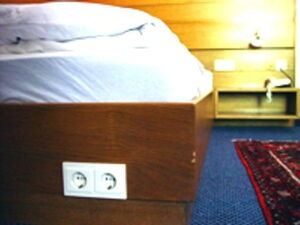
Beds should be at least two metres away from electric hot-water boilers and storage heaters, refrigerators, electric cookers, washing machines, heating pumps, television sets, hi-fi systems, fuse boxes, roof-mounted power supply masts and all similar sources of radiation. Bear in mind that electromagnetic radiation penetrates walls, ceilings and floors and that a reduction can only be achieved by greater distance or shielding materials (see below).
Fig. right: socket in a hotel room...
Disconnect electrical appliances that are not constantly in operation (televisions, coffee machines, office machines) completely from the power supply when not in use. It is practical to use switchable multiple sockets or switchable plugs, or pull the mains plug out of the socket.
Make sure that your head is at least one metre away from heating and water pipes. Equalising currents often flow through these pipes, generating alternating magnetic fields in the immediate vicinity of the pipes.
Use heating pads and electric blankets only to warm the bed; heating pads and electric blankets that are switched off but still connected to the mains can also cause very strong electromagnetic fields.
If you do not want to do without a clock radio in the bedroom, use a battery-operated one or keep a distance of one metre from your head.
Power cables for lamps and other electrical appliances from which the distance cannot be increased should be replaced by shielded power cables that are metal-sheathed.
Automatic mains disconnectors: Their simple installation in the fuse box ensures that electrical wiring, lamps and electrical appliances are live only when electricity is actually needed.
Shielding foil: If the electrical wiring of a wall against which a bed stands cannot be made voltage-free at night by an automatic mains disconnector, the sleeping place can be shielded by a shielding foil specially developed for this purpose, which is fixed to the wall, dimensions 80x190cm.
Arbor shielding paint: In contrast to the shielding foil, it is suitable for larger areas. The shielding paint can be applied to plastered surfaces, painted walls, wallpaper, plasterboard, wood, wood-based materials and similar substrates, and can itself be painted or papered over as desired.
Mu-metal foil: This is a magnetic shielding foil with which a considerable reduction of magnetic fields, or with several layers even complete shielding, can be achieved. It consists of a special nickel alloy with an adhesive layer. The thickness is 0.05mm, the roll width approx.15cm.