The undisputed winners of anti-ageing medicine are not the hormones, but sufficient sleep, exercise and healthy food. Nevertheless, hormones continue to be presented as the key to the fountain of youth. In fact, the whole of anti-ageing medicine began with them, back when gynaecologists introduced hormone replacement therapy in the postmenopause. Hormone levels like those of the young: that was, and to this day widely remains, the credo.
Hormones do indeed have far-reaching effects on our body. They are also important links between our organ functions and our brain. This overview presents the most important sex hormones one by one, oestrogen, progesterone and testosterone, and explains how a deficiency can be recognised, how we measure the hormones and how treatment is structured.
Oestrogen
The possible influence of oestrogen on a woman's health and well-being is enormous. With its varied and seemingly paradoxical mode of action, this important hormone can act quite differently on many conditions, such as breast cancer, osteoporosis, heart disease and autoimmune diseases.
Effects of oestrogen
- Promotes the build-up of the lining of the uterus
- Stimulates the breast
- Increases the body's fat content
- Slightly restricts the function of the bone-resorbing cells
Side effects of oestrogen
- Increases blood clotting: risk of infarction and embolism
- Reduces sexual desire
- Worsens blood sugar levels
- Loss of zinc and storage of copper
- Reduces the oxygen level in the cells
- Increased risk of breast cancer
- Increased risk of uterine cancer
- Inhibits the excretion of salt and water: fluid retention
- Promotes depression and headaches
- Reduces the effect of the thyroid hormones: underactive thyroid, sluggish metabolism
- Reduces the tone of the blood vessels: vein and vascular problems
Oestrogen metabolism: two pathways
Recent research shows how oestrogen is broken down in the body. These findings help us to understand the dual nature of oestrogen and to treat more effectively. Oestrogen is metabolised along two pathways.
One pathway produces a highly active metabolite, 16-alpha-hydroxyoestrone (16alpha-OHE1), which stimulates the target tissues. Its concentration can rise as a result of obesity, alcohol consumption and toxic load. High concentrations are associated with an increased risk and a poorer prognosis in conditions such as breast cancer and lupus, that is, in diseases that are linked to an excess of oestrogen.
Along the other pathway, the body breaks oestrogen down into a very much less active metabolite, 2-hydroxyoestrone (2-OHE1). It binds only weakly to cell receptors and can inhibit cell proliferation. Greatly raised concentrations can, however, increase the risk of conditions that are linked to oestrogen deficiency, such as heart disease, depression and osteoporosis.
An appropriate balance between the two metabolites is thus decisive for a health-promoting oestrogen metabolism. Measuring them allows an individually tailored therapy that takes a patient's particular health risks into account.
The E2/E16 ratio
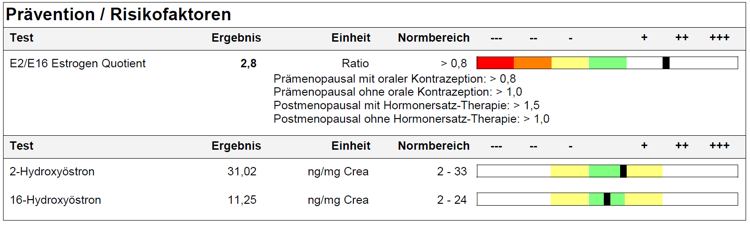
Breakdown to 2-OH oestrogen is regarded as the safe pathway, whereas 16-OH oestrogen has carcinogenic properties. The ratio of 2-OH to 16-OH should therefore be as high as possible. Low ratios increase the danger of breast and cervical cancer, and of prostate carcinoma in men.
The ratio can be influenced favourably by:
- Antioxidants
- Glutathione
- Grapefruit juice
- Hemp isoflavones
- Indole-3-carbinol
- Broccoli
- Cabbage
- White cabbage
- Linseed
- S-adenosylmethionine
- Soya
Soya products (flavonoids), linseed (lignans), vegetables from the cruciferous family (indole-3-carbinol), physical exercise and omega-3 fatty acids can also reduce the risk of oestrogen-dependent diseases, because they favourably influence the ratio of 2- to 16-alpha-hydroxyoestrone.
The analysis of oestrogen metabolism
This serum test provides information about oestrogen metabolism in the female body. It supplies clinically important information on many oestrogen-dependent conditions and is a valuable instrument for monitoring hormone therapies, including hormone replacement therapy: it gives an insight into their safety and effectiveness.
The analysis is indicated both before and after the menopause. It measures the hydroxyoestrone metabolites circulating in the blood, which can act directly on the target tissues. It is therefore an informative and inexpensive test for monitoring the immediate effects of a hormone therapy on the female organism.
Progesterone
Progesterone protects against the unwanted side effects of oestrogen, regardless of whether these occur before the menopause through the body's own oestrogen or as a result of oestrogen replacement. Establishing a hormonal balance is understood to mean restoring a healthy progesterone level.
Effects of progesterone
- Maintains the lining of the uterus and the embryo during pregnancy
- Protects against cysts in the breast
- Helps to convert fat into energy
- Promotes the excretion of water in a natural way
- Natural remedy for depression
- Promotes the utilisation of thyroid hormones: underactive thyroid and sluggish metabolism improve
- Normalises blood clotting
- Normalises the zinc and copper balance
- Restores a normal oxygen level
- Protects against uterine cancer
- Protects against breast cancer
- Stimulates the bone-building cells: effective protection against osteoporosis
- Forms the body's own cortisone: relieves rheumatic pain and allergies
Side effects of progesterone
Tiredness, otherwise none.
Testosterone
With increasing age, the activity of the testes declines, and the concentration of free, bioavailable testosterone falls sharply. By the age of 50, the release of testosterone has fallen by half. The main reason is the chronic loss of the Leydig cells in the testes; but the changed activity of the system of hypothalamus, pituitary gland and gonads and the increase in sex hormone-binding globulins (SHBG) also contribute.
Testosterone exerts a strong influence on emotions, cognition, sexual function, muscle mass and strength, energy balance, the health of the heart and blood vessels and the strength of the bones. A testosterone deficiency can therefore have very different consequences for health. Because the hormone acts at the same time on the immune system, the metabolism and inflammatory processes, disturbances in the testosterone balance are found in a large number of diseases: from rheumatoid arthritis, heart conditions, insulin resistance and AIDS to obesity, osteoporosis and prostate carcinoma.
In some of these diseases, the testosterone balance is rarely taken into account, and the andropause generally runs its course with few symptoms. A chronic androgen deficiency is therefore usually overlooked. An accurate assessment of the testosterone level is important, however, in order to estimate how far this hormone is involved in chronic diseases and degenerative ageing processes.
The male hormone profile
The release of testosterone is examined with saliva samples collected in the morning, at midday, in the afternoon and at midnight. Compared with measurement in serum, which captures both the bound and the unbound hormone, saliva analysis has the advantage that only the free, bioavailable fraction is measured.
How a hormone deficiency can be recognised
Oestrogen deficiency
- Sagging breasts
- Dry mucous membranes (esp. vaginal, eyes, mouth)
- Fine wrinkles
- Hot flushes
- Light or absent menstruation
- Early menstruation
- Painful abdominal cramps during menstruation
- Headaches during menstruation
- Joint pain
- Constant tiredness
- Depression
- Loss of libido
- Premature ageing
- Osteoporosis
- Cardiovascular diseases
Progesterone deficiency
- Painfully swollen breasts
- Swollen abdomen, legs, arms, fingers
- Excessively heavy menstruation
- Constant abdominal pain during menstruation
- Headaches before menstruation
- Premenstrual syndrome
- Excessive nervousness
- Anxiety, irritability
- Light sleep
- Cysts in the breast and ovaries, and uterine fibroids
- Breast and uterine cancer
Testosterone deficiency
- Loss of muscle mass
- Muscle weakness
- Wrinkles
- Loss of emotional strength
- Tendency to overdramatise
- Loss of initiative and self-confidence, hesitant
- Loss of libido
- Premature ageing
- Osteoporosis
Assessment: the oestrogen-progesterone profile in saliva
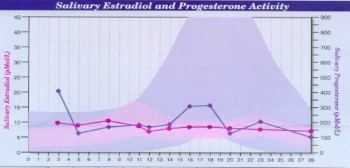
Normal laboratory analyses cover only a single blood sample. Such a snapshot reveals, at best, a pronounced deficiency or excess. This hormone profile, by contrast, examines saliva samples for oestradiol and progesterone over 28 days; in addition, testosterone is measured. The concentrations of oestradiol and progesterone and their ratio are plotted as a graph, so that the whole month can be assessed at a glance. Deviations give indications of cycle irregularities, infertility, PMS and other chronic gynaecological disorders.
Measuring hormones in saliva has further clear advantages. Measurement in serum captures both the bound and the unbound hormone; the saliva concentration reflects only the free, bioavailable fraction. Various factors such as obesity and thyroid function influence the sex hormone-binding globulins. Functional disorders can therefore be recognised better with saliva analyses.
Menopause
The postmenopause is characterised by a marked fall in oestrogen production and by pronounced physiological and anatomical changes. Many women hardly notice the transition into this phase of life. In others, the falling hormone levels cause symptoms such as hot flushes, vaginitis, dyspareunia, memory problems, changes in fat metabolism and premature ageing of the skin.
By the time the menopause is reached, oestrogen production has fallen by 70 to 80 per cent and androgen production by 50 per cent. These changes can increase the risk of developing osteoporosis or cardiovascular complaints. In addition, immune regulation, mood, sugar regulation, libido and cognition are impaired. Because the adrenal glands play a significant role in the menopause as suppliers of the hormone precursors, a disorder of the adrenal glands can have a marked effect on the deficiency of sex hormones.
Measuring the baseline levels of oestradiol, progesterone and testosterone is decisive for the decision as to whether hormone replacement therapy is necessary. Normal hormone levels require no treatment. If the analysis shows deviations in individual hormones, the doctor can determine the type and dose of a hormone treatment precisely and individually. High concentrations of oestrogen and testosterone mean an increased risk of breast and uterine cancer. Measuring the sex hormones thus helps to find the causes of varied symptoms, to recognise risks of more serious diseases and to estimate the possible benefit of hormone replacement.
Hormone treatment in women
| TREATMENT | PERIMENOPAUSE | POSTMENOPAUSE |
|---|---|---|
| Oestradiol (E2) gives energy leads to water retention | Day 5 to 25 of the cycle | Use from day 1 to 25 of the month |
| Progesterone calms and removes water retention Take before going to sleep | Day 18 to 26 of the cycle | Use from day 13 to 25 of the cycle |
| Androgens / testosterone strengthens mind and muscles | Continuously | Continuously |
If the symptoms persist despite hormone replacement, the dose must be increased.
Source: Dr T. Hertoghe, Brussels