“Whoever wishes to stay strong, healthy and young should be moderate, exercise the body, breathe pure air and heal his ailments by fasting rather than by medication.” Hippocrates 460 to 370 BC
It cannot be emphasised enough how fundamentally important the cleansing of the body’s fluids and cells is for recovery and health. Our body is accordingly equipped with a rich arsenal of detoxification mechanisms. The lungs breathe out the harmful carbonic acid and other gaseous breakdown products, the kidneys filter off the toxins that can be excreted in the urine, and the skin also eliminates waste deposits through skin respiration (perspiration) and sweat. The gut cleanses by excreting solid waste. This consists of food residues that have remained unused, the secretions of intercellular metabolism that stem from the cleansing of the blood, the gut bacteria and cells of the mucous membrane. However, the gut is also responsible, as an organ of absorption, for taking up the necessary nutrients and is, so to speak, the soil for us “human plants”. If the soil is poor, we will not thrive, or will even fall ill. Our basic state of well-being is severely disturbed.
How do we know whether our gut is working properly?

The stools produced by a healthy digestive system should have the following characteristics: sausage-shaped, with rounded ends, and smooth on the surface owing to a coating of mucus. Because it contains no gas and no excessive fat, the stool sinks in water and has only a slight characteristic odour. It must smell neither strikingly foul nor sour (a sign of putrefaction in the gut). Passing the stool should not soil the anus, just as infants and small children remain unsoiled after passing a stool into the nappy. The consumption of toilet paper is a measure of the digestive damage within us and of our “civilised” society. Healthy animals do not soil themselves when passing stools either. This is how the vet recognises a disease of the gut!
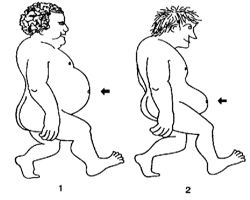
When the gut is sluggish, food remains in the gut for too long. We always pay attention to the use-by dates on food packaging. Who cares if the food stays even longer in our gut.... And the temperature there is not that of a refrigerator but that of an incubator! Meat, sausage, fish, fruit salad etc. spoil, are decomposed and can become so toxic that, in the form of an injection, they are capable of killing a laboratory animal. In us they lead to irritation of the mucous membrane, formation of gas, distension of the abdomen and flatulence, especially when blockages occur in the onward transport of the food pulp and the mixing with digestive juices, which digest and prevent spoilage, is disturbed. The belly can be hard and taut like a drum (gas belly, Fig. 1) or flabby and hanging down (faecal belly, Fig. 2).
Unfortunately, in contrast to many other diseases, chronic functional disorder of the gut remains silent for a long time, provided one ignores, or “remedies” with medication, symptoms such as belching, heartburn, a feeling of fullness, flatulence, stool problems, but also (when the toxins enter the bloodstream) headaches, dizziness, mouth, sweat and body odour, low mood, rheumatism, exhaustion, heart complaints, and so on.
Fasting
It goes without saying that the car has to be serviced every 10,000 km. For that we spare hardly any effort, time or money. What about our health? We go on holiday, and out of boredom and because of the heat we lie around or drink beer, eat ice cream and nibble sweets, drink coffee and help ourselves generously at the lavish buffet. No, this is not a recovery for the organism, at most (and even this rather rarely) for the soul. Anyone who also wants to recover in terms of health must seriously consider the possibility of a fasting cure. When we are ill, we have no appetite either. The body cannot cope with the additional burden of digestion. Voluntary abstention from food for a limited time holds an incredible healing power. There is hardly a major religion that does not recommend that its believers cleanse body and soul every year by fasting. Fasting is the prevention of disease par excellence. Fasting is not to be confused with “starving”. The latter denotes a harmful undersupply of nutrients, for example through hunger strike, famine and considerable functional disorder of the gut in processing food (for example cancer).
Mayr cures
are individually designed cures of fasting, diet and gut regeneration. They comprise tea fasting and therapeutic fasting, the milk diet cure with bread rolls, and extended forms of light diet. As strict tea fasting and therapeutic fasting should be carried out under inpatient conditions at a health resort, we limit ourselves to the classic Mayr bread roll cure, which is excellently suited to being carried out at home on an outpatient basis as well. What does this cure achieve?
- TRAINING Education in eating correctly. That is, always take only small bites, chew them into the tiniest particles and almost liquefy them in the mouth through conscious, intensive mixing with saliva. Eating correctly also brings about better mechanical cleaning of the teeth and better blood flow to the gums and the roots of the teeth.
- REST and CLEANSING of the digestive organs: appropriate use of milk and bread roll.
- Long-lasting SATIETY at least twice a day. You do not have to go hungry.
The fasting crisis
As a consequence of the cleansing, decomposition products may be abruptly absorbed into the blood. This “re-poisoning” of the organism with the waste deposits that have been set in motion triggers the crisis. It may show itself as headaches, loss of appetite, nausea, drowsiness, dizziness, bad mood, irritability, tiredness, weakness, visual disturbances and others. The crisis usually begins suddenly and lasts minutes to hours, occasionally days. During the crisis in particular, plenty of fluid must be drunk. Giving alkalising preparations to neutralise the acids that arise can also end the crisis.
Criteria of recovery according to Mayr
Tightening of the face, regression of signs of poisoning, reduction of double chin and wrinkles, normalisation of posture and with it of the neck in shape and length, reduction of the distance between the shoulder blades, narrowing of the lower parts of the chest and of the hips, the belly becoming smaller and softer, re-formation of the waist, drawing in of the protruding buttocks through reduction of the abnormal pelvic tilt, reduction of increased curvatures of the spine, and in general an increasingly well-formed body. The skin improves its firmness and sagging areas of the body recede. These results of treatment sometimes become fully apparent only a few months after the end of the cure.
Important: the so-called epigastric angle
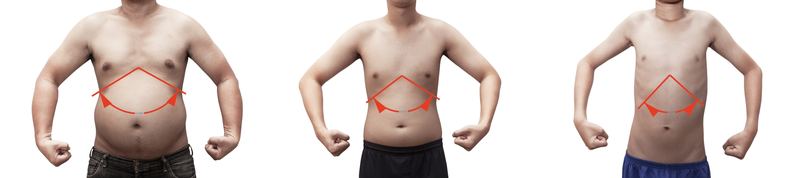
The more space the belly takes up, the wider the central angle becomes that is formed by the rib cage towards the breastbone. The larger the belly, the less space is available to the heart and the lungs, which means an increasing strain on the circulation.
Note how the neck also becomes shorter as the angle increases.
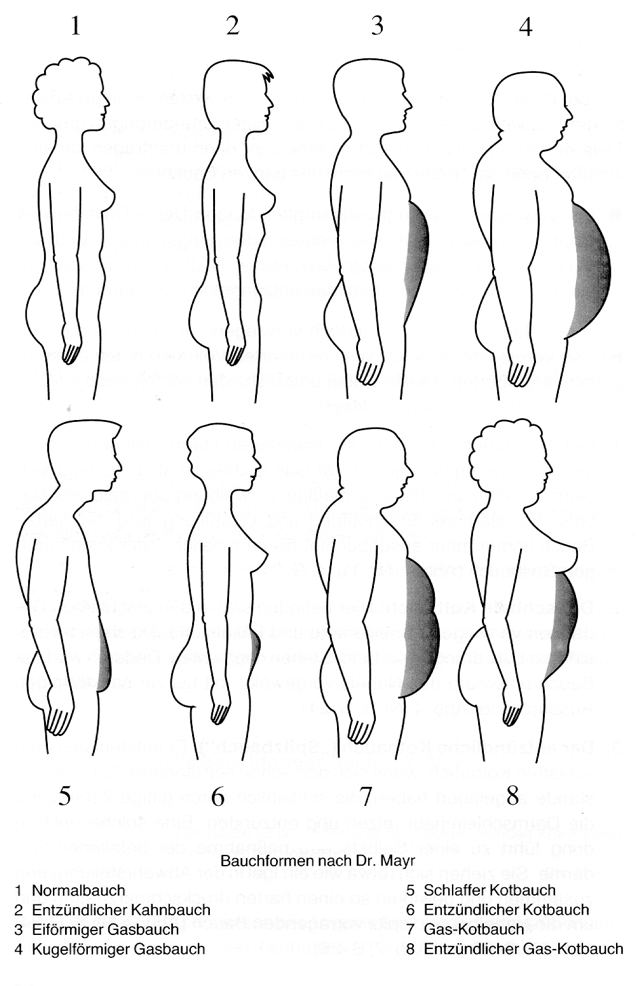
Belly shapes according to Mayr
Literature
Published by Haug Verlag:
- Leitfaden zur F. X. Mayr-Kur, Dr. med. Bodo Werner
- Die Darm-Reinigung, Dr. med. Erich Rauch
- Blut- und Säfte-Reinigung, Dr. med. Erich Rauch
- Die F.X. Mayr-Kur... und danach gesünder leben
Procedure: introduction
The milk
It contains all the essential sources of calories and micronutrients and is a protective food. Milk should not be regarded as a drink for quenching thirst. It is liquid food. It should be taken as an infant takes it, sipping and sucking (in order to stimulate saliva), only in the smallest portions and thoroughly mixed with saliva.
The bread roll
The condition of the roll (a bread roll made from fine white flour) is decisive for the success of the cure. The rolls are bought fresh and stored for about one day in a dry room. After that they should be wrapped in cellophane. After about two days they reach the right condition: firm enough to slice and only just yielding to pressure (the consistency of a rubber eraser). You must always ensure a sufficient supply of rolls and enough choice. Rolls that are too fresh and soft do not have the swelling capacity of the cure roll and cannot be chewed and mixed with saliva sufficiently. They are poorly utilised, which leads to premature hunger, distension of the abdomen and insufficient rest for the gut. Caution: rolls stored in a steamy kitchen or in containers (bread bin) remain too moist! Rolls that are too hard (“rolls for grating”) and rusks do not have the swelling capacity of the cure roll and do not stimulate the flow of saliva as much. However, they are more favourable than rolls that are too soft. Flatulence during the cure very often points to the wrong condition of the rolls or to incorrect eating.
Many followers of wholefood and healthy-eating diets believe they must reject the Mayr cure because the roll, as a white flour product, is biologically worthless. But during the cure the roll is not meant to supply biological value at all; it is meant to serve only as a trainer for chewing and mixing with saliva! Only in this way can the wasted salivary glands be got going again. In addition, the cure roll is a pure light diet. We do not want any dietary fibre during the cure. Of course, this does not mean that you should eat white flour products after the cure!
The bread roll
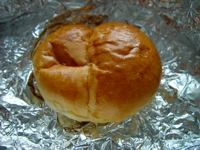
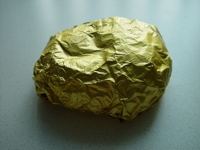
Roll, wrapped
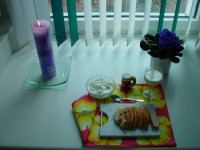
Mayr trial meal at the SGK
What to do in case of yeast or wheat intolerance? Spelt flatbreads!
Recipe: 250g freshly ground spelt flour + a pinch of salt + 2.5 dl highly carbonated mineral water. Stir everything together briefly in a bowl. This batter makes 8 flatbreads (place directly on the baking tray with a spoon). Bake at 250 degrees for 10 min., then turn and leave in the oven for another 5 min.
How to eat
Before each meal, cut the roll into slices about half a finger thick. The piece is chewed until a liquid pulp of roll and saliva with a slightly sweetish taste has formed (the starch of the roll is converted into sugar). Now a small spoonful of milk is sucked in. The entire contents of the mouth are mixed by further chewing movements. In the process, the digestion of the milk already begins vigorously in the oral cavity, which is essential for the success of the cure. Only then do you swallow. Now the act of eating begins again from the start, until a slight satiety is reached. The amount is not prescribed, but as a rule one roll is sufficient. In any case, “leftovers” must be left. Never pour down the remaining milk afterwards. Without exception it is “eaten” by the teaspoonful with the pulp of roll and saliva, or not at all. Suitable as further additions are low-fat quark (lightly salted if required), a little honey with the evening tea, sheep’s milk yoghurt in case of milk intolerance and spelt flatbreads in case of wheat allergy. During the morning break, a well-seasoned bouillon and/or herbal tea can be taken. In the evening no more roll should be eaten; only tea (possibly with a little honey) and/or bouillon should be drunk.
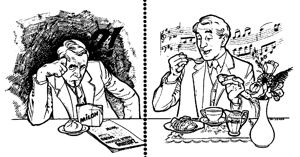
Please note that there must be no talking while eating. Only those who remain silent during the meal and concentrate on chewing are eating correctly. There must be a pleasant and unhurried atmosphere. A wrong way of eating and a poor attitude to the cure programme hunger, irritability, sullenness and failure.
By the way... A toothless patient suffered from diarrhoea and inflammation of the gut. As soon as he had begun to purée his food, his bowel movements returned to normal!
At least 5 to 6 hours should pass between meals so that the stomach can empty completely. Do not try to “embellish” the food through variety, for example roll on one day and spelt flatbread on the next, and so on. Monotony is decisive for the right (modest) amount of food. Anyone who eats a varied diet automatically eats more than they should.
Every gut cleansing cure is also a drinking cure. Suitable are: good drinking water, herbal teas, low-carbonated (still) mineral waters. The drinks should be taken neat and neither too cold nor too warm. Drinking often, spread over the day, but less with meals(!), very substantially supports the flushing out of harmful substances. Unless otherwise prescribed, 2, 3 or 4 litres should be drunk daily, depending on body weight (up to 50 kg, up to 80 kg, above that). Depending on need, the following may be considered:
- Lime blossom: support of detoxification via the kidneys and skin
- Fennel: promotion of the release of wind and of gut detoxification
- Silverweed: relief of cramps in the gut and kidneys
- Yarrow: stimulation of the portal circulation and of the female functions
- Lemon balm: strengthening of nerves, heart and female organs
- Horsetail: promotion of excretion by the kidneys and strengthening of the skin
- St John’s wort: acceleration of mental regeneration
Herbal teas support the processes of detoxification and excretion. In addition, they contain mineral salts, vitamins, trace elements, enzymes, fragrances and flavourings.
Rest
In general, a certain amount of rest is required. Resting for half an hour, or at least a few minutes, before eating, occasional short breaks for relaxation and going to bed early regularly are absolutely necessary. No television in the evening and no baths that are too hot. This cure should also be used to reduce the rush of everyday life as far as possible.
Cleansing
At the beginning of the Mayr cure, the gut is cleansed with Carlsbad salt or Epsom salt (magnesium sulphate). If possible, this is also continued during the cure. One level teaspoon of salt is added to ¼ litre of warm water. To improve the taste, the Epsom salt can be mixed with a little water the evening before and topped up with hot water in the morning. In addition, 3 to 4 drops of lemon juice may be added. This “drink” is taken in the morning immediately after getting up. Breakfast should follow only half an hour to three quarters of an hour later, when the salt solution has already left the stomach again. A combination of this type of cleansing with colon hydrotherapy (separate information brochure) is ideal. If toxins that are particularly irritating to the gut are being excreted, frequent, watery and usually foul-smelling, discoloured evacuations may occur. Occasionally the mucous membrane of the anus also swells temporarily, reddens and feels sore. Constipation also occurs when toxins with a paralysing effect on the gut are excreted. Otherwise, a stool that stems solely from the milk and roll diet is golden yellow and almost odourless, that is, similar to that of an infant. Any other colour or a foul odour betrays the passing of poorly digested, harmful residues. In most cases the impurities come loose at the beginning of the cure. The longer and more intensively the body has been exposed to the contamination, the longer its thorough cleansing takes. Father Kneip: “You do not clean out such an old house in a single day!”
Abdominal treatment
Of eminent importance is the abdominal treatment according to F.X.Mayr, carried out at least every second day, or better still daily. In this treatment, the abdominal wall is carefully massaged with a special technique and congestion of the bowels is relieved.

As a result, the intestines begin to work better, the lungs can take up more oxygen because of the reduced pull of the bowels, the position of the heart returns to normal and with it, immediately, the circulation and the supply of micronutrients to the tissues as well as the removal of waste deposits. This becomes noticeable, for example, in the immediate improvement in the firmness of the skin (skin fold test on the back of the hand).
Liver compress
To support liver function, a warm hot-water bottle can be placed on the right upper abdomen for about 15 min. The effect is intensified by placing hay flowers underneath and covering with a towel.
Rule to remember:
“After eating you should rest, or take a thousand steps.”
Example of a daily routine
| 7.00 am | Taking of Carlsbad salt |
|---|---|
| 07.15 | Light morning exercises. Caution, no exercises with the head lowered. Dizziness and a tendency to faint during the cure |
| 07.45 | Breakfast: 1 roll, milk, 50g low-fat quark, a pinch of salt (duration of breakfast about 45 min!) |
| 10.00 | Snack during the break: 1 to 2 soup cups of bouillon, herbal tea |
| 13.00 | Lunch: as breakfast (45') |
| 15.00 | Doctor’s appointment for abdominal treatment |
| 16.00 | Snack during the break: herbal tea |
| 19.00 | Evening meal: bouillon, herbal tea sweetened with a little honey, possibly slices of orange squeezed into the tea (do not eat the fruit!) |
| 22.00 | Liver compress |
| 22.15 | Taking of alkaline powder |
Drink plenty in between!
What to do when hungry and thirsty
If you eat as prescribed, satiety lasts a long time and hunger is rare. It occurs almost only when you eat hastily, carelessly or wrongly (drinking the milk instead of spooning it), or when the rolls are too fresh and too soft. When you feel hungry, you should always drink. Should the hunger nevertheless persist, a cure roll (or only part of one!) may, by way of exception, be eaten outside the set mealtimes, chewed slowly and correctly, of course, and mixed with milk. With increasing recovery, the need to eat outside mealtimes disappears of its own accord in most cases.
End of the cure
This is the most difficult time and takes place gradually. Now of all times you must not become careless; you must observe all the rules most thoroughly and mix with saliva and chew even more thoroughly than before. The smallest errors in diet and eating now make themselves felt severely. The freshly renewed mucous membranes are still delicate and react to anything that does not yet agree with them, for example “scratchy” cellulose-rich food, with an intense feeling of soreness. Remember that it is no longer the greedy consumption of larger amounts of food that should provide the desired pleasure, but the savouring and tasting of every bite. Quality should replace quantity. Dishes that used to be favourites are suddenly rejected, such as fatty roasts, bacon, pastries and complicated and elaborately composed dishes, or also chocolate, alcohol, liqueur and real coffee. A little butter or fine margarine (health food shop), honey, quark or cream cheese can be used as a spread on the roll. Suitable as an accompaniment are a soft-boiled egg, tender steamed vegetables, potato-based vegetable soups, boiled potatoes (no chips!), maize semolina, quark, cottage cheese, steamed lean veal, chicken or trout au bleu. Later, root vegetables such as carrots, parsley and black salsify, as well as fine salads, lettuce, celery, fennel and a little spinach. For breakfast and at the beginning of lunch, a little fruit is suitable: banana, peeled or cooked apple, berries, also in milk or yoghurt. Soya dishes such as tofu and cereal dishes made from easily digestible oat flakes or from maize semolina, buckwheat, millet etc., garnished with fragrant herb sauces, are usually also well tolerated. The cure roll is gradually replaced by wholemeal bread, crispbread etc.; butter and mixtures of quark, oil and herbs serve as spreads.
Mild derivation diet
80% of all risk factors, disorders and ailments that plague millions of affluent citizens in Western countries, as well as up to 80% of all causes of death, are today attributed to diet-related diseases. This enormous prevalence of damage to health through wrong nutrition can also be recognised in the belly shapes (so-called pointed, gas and faecal bellies) and postures of our fellow human beings. But it is not only the overweight; the thin who are forever tired and listless can also clearly be seen to belong to those damaged by nutrition and digestion. To all those affected in this way Dr. Mayr prescribed his fasting and diet cures and achieved outstanding results with them. The mildest form of cure that has developed from these Mayr cures is the “mild derivation cure” with its three stages, which can be individually adapted to how much strain each person’s digestion can bear. This therapeutic diet serves primarily to improve the condition of the digestive system, since good nutrition and good health can be achieved only through good digestion. This is the aim of the mild derivation cure with the mild derivation diet. It is rightly said: when the belly is purified and slimmer, one lives more lightly, more gladly, longer! The key position of the digestive organs for health as a whole results from their activity as the “root system of the human plant”.
The “mild derivation cure” is suitable:
- For the prevention of disease
- For raising the basic level of health
- For promoting the healing of the most varied disorders, diseases and infirmities
In addition, the mild derivation cure and diet is an ideal transition from fasting, diet and gut cleansing cures to a healthier, individually shaped long-term way of eating. The mild derivation diet lies midway between a strict light diet and a wholefood diet.
Guidelines of the mild derivation diet
- Mild food that rests (and heals) the digestion, as the most important guideline
- Preparation that eases digestion and preserves as much nutritional value as possible
- Use of biologically high-quality products
- Emphasis on alkali-providing foods
- Moderate monotony as a factor of rest
- Consideration of individual intolerances
- a) Eat only what, from your own experience, is well tolerated and easily digestible
- b) Avoid everything that is burdensome, hard to digest, causes flatulence and forms acid
Foods prohibited in the mild derivation diet for the duration of the cure
- Cellulose-rich food that burdens the digestion: heavy fresh breads, wholemeal breads and wholegrain dishes, coarsely ground grains, heavy vegetables, pulses, white cabbage, savoy cabbage
- All raw food: fruit in any form, including compotes, fruit juices and tinned fruit
- Fatty dishes, anything made with a roux, anything baked or breaded, pork and pork fat, sausage products, hydrogenated and refined oils and fats, animal fats, mayonnaises
- Industrial sugar, including brown sugar, Dextropur, sweets, confectionery, boiled sweets, sweet dishes, chocolates, jams
- Real coffee, including decaffeinated, all industrially produced drinks, alcohol, cola drinks; recommended: water, mineral water, herbal tea, malt coffee
- Nicotine
- Medication, unless prescribed by the doctor for other reasons
Permitted exceptions:
- 1 to 2 tsp of lemon and orange juice in the herbal tea, banana from derivation diet stage III
- Butter, cold-pressed vegetable oils
- Honey, molasses, pear concentrate
Recommendations of the mild derivation diet
Milk and dairy products, cream, Topfen (quark), easily digestible types of cheese (cream cheese and others), tender (!) steamed vegetables of all kinds, vegetable soups, boiled potatoes and potatoes boiled in their skins, egg, tender meat and fish dishes, easily digestible types of cereal, oat flakes, maize semolina, millet, rice, stale baked goods, yeast flakes, cold-pressed vegetable oils with highly unsaturated fatty acids, honey, native herbs and spices, sea salt, mineral water, herbal tea, malt coffee and others.
Practical procedure
Eating milk and roll provides the training required for this: the cure roll is cut into thin slices, on each of which a knife tip of quark can be spread. A small (!) bite of this is chewed until a liquid pulp of roll, quark and saliva forms, which finally takes on a slightly sweetish taste. Sweetish, because the salivary enzymes have broken down the starch of the roll into sugar. Do not swallow yet! Now a small spoonful of milk is “sipped” with it (taken like soup) and mixed in the oral cavity with the pulp of roll, quark and saliva, so that the salivary enzymes can also predigest the milk. Only then do you swallow. You eat in this way until slight satiety is reached. Then stop immediately.
Important! The way in which food is taken is decisive for the success of the cure! Without the prescribed eating culture no success can be achieved!
Monotony: you are free to choose among the variants listed for breakfast, but the breakfast and the evening snack of the mild derivation diet (MAD) should always be largely the same, or be changed as rarely as possible, since monotony is an important factor of rest and healing.
Anyone who correctly practises the eating culture according to Mayr at their meals achieves a pleasant, long-lasting satiety, because food that has been ideally predigested in the mouth is better utilised. Between breakfast and lunch there should, if at all possible, be a break of around five hours. If breakfast is eaten correctly, a healthy feeling of hunger usually sets in only a short time before lunch.
Cultivating hunger (appetite): a healthy feeling of hunger that is in no way tormenting or, which is the same thing, a hearty appetite some time before the next meal is the precondition for taking another meal. If this is lacking, you should definitely wait before eating, even at the “risk” of skipping a meal for once.
- Without hunger, no eating!
- Without hunger, no good digestion!
- Without hunger, no health!
Therefore cultivate the onset of your hunger!
Mild derivation diet: MAD I
Breakfast
You may choose from:
Milk (+ malt coffee) + cure roll + Topfen (quark)
- Milk: if available and tolerated, raw milk briefly warmed to the desired temperature is the most favourable. Choose the type of milk that, from your own experience, agrees with you best; certified raw milk (Vorzugsmilch), baby milk or good types of soured milk (Sanoghurt, Biogarde, Bioghurt) are recommended.
- Malt coffee: causes the fresh milk to curdle into flakes, which makes it particularly easy to digest. Also proven as baby food. All types of ready-made malt coffee are permitted. Anyone who tolerates milk very well can take it on its own; otherwise the addition of malt coffee is more favourable.
- Cure roll: this is a stale white bread roll. Although it is a food of low nutritional value, it is of enormous importance for the cure as an easily digestible school of eating and chewing. After the cure it should, if tolerated, be replaced by biologically more valuable bread. The cure roll must be stale, 3 days old, firm enough to slice and hardly yielding to pressure any more, so that it forces the most thorough chewing and mixing with saliva! Rolls that are too fresh and soft are unsuitable! The rolls, which are to be bought fresh every day to keep in stock, should be stored in neat rows and air-dried in a dry room on a rack, on a cloth or greaseproof paper. Before eating, they are to be cut into 9 to 10 small slices. The cure roll is used as a school of chewing throughout the whole mild derivation cure. If the rolls are too soft, they can be cut up earlier, so that they air-dry more quickly (emergency solution).
- Quark: it is best to use 10% low-fat quark at first.
Herbal tea + cure roll + quark
Herbal tea: as you choose. Silverweed and fennel have a mild cramp-relieving effect, lemon balm and St John’s wort calm the nerves, and lime blossom is also particularly pleasant in taste.
Preparation: a pinch of tea (the amount picked up with 3 fingertips) is placed in a fine sieve, scalded with boiling water (¼ litre), left to infuse for 2 minutes and strained. If permitted and tolerated, one teaspoon (tsp) of genuine bee honey (no more) and a little lemon or orange juice are added.
Bee honey contains glucose, fructose, trace elements, amino acids, enzymes and inhibines. Keep in a well-sealed container and never heat above 50° C, as otherwise the enzymes are destroyed. Honey is to be used as a seasoning. Do not exceed the stated amount! or: oat, wheat or rice gruel
Lunch
The meal of the MAD begins with alkaline soups (puréed vegetable soups). These are made from various vegetables, mainly those in season, without fat and without flour (“right across the vegetable garden”). They contain numerous micronutrients that the body can easily absorb in this form, above all minerals and trace elements, and supply alkaline substances to the organism, which during the cure is freeing itself of harmful substances, especially of acids such as uric acid. In this way they support the healing processes. As the diet of people today consists predominantly of foods that form acid and deplete alkali, alkaline soups are also to be recommended as part of a long-term diet.
Caution! All soups, gruels or other dishes that are difficult to mix with saliva should be taken with the cure roll, which forces you to chew!
Cooking alkaline soups should always mean letting them simmer slowly in a covered pan. If the heat is too high, too much liquid would evaporate and the soups would become too thick in consistency. Alkaline soups taste best when they are puréed in a blender and served immediately. With unsprayed, fresh young vegetables, thickening is not necessary! Stage 1 offers the optimum rest; after that the diet is slowly enriched and more is demanded of the digestion. Many further variants of alkaline soups can be prepared with individual mixtures of vegetables.
These “easily digestible alkaline soups” are also to be recommended outside the MAD (mild derivation diet). Other types of vegetable can then also be used. Diced and steamed vegetables can be added to the alkaline soup as an extra garnish. A little fresh vegetable can also be blended in at the end.
The main dishes include:
- Tender, easily digestible and gently prepared vegetables
- Easily digestible cereal dishes prepared so as to agree with the digestion
- A little meat or fish about every third day.
The dishes are simple and quick to prepare. Cereal dishes are given additions of vegetables; meat and fish dishes are always served with alkaline sauces and potatoes, in order to balance the acid-providing effect of meat or fish.
Evening meal
During the mild derivation cure, no evening meal or almost no evening meal is taken, because the intake of food in the evening is the least favourable. Instead, one, two or three cups of any herbal tea, possibly with a teaspoon of honey and a little lemon or orange juice, are taken by the spoonful. Taking the hot tea by the spoonful usually produces an astonishingly good feeling of satiety. Should there nevertheless be genuine hunger, a little Topfen (quark) diluted with milk is additionally permitted, which is taken with a little cure roll for better mixing with saliva. However, you should stop eating as soon as slight satiety is reached. For the whole cure the rule is “cultivating hunger”, because: “Hunger heals!”
This means that when the body receives so little food that a healthy feeling of hunger arises some time before the next meal, the digestive system can put its interior in order, tidy up, and digest and shed old waste deposits. While the digestive system is empty, which is felt as hunger, the most important healing processes take place! In most cure patients, however, only slight hunger arises during the whole derivation cure, even in the evening, since the body is now living off its reserves that are due for breakdown, its “rubbish dump” and its fat stores. Anyone who complains of hunger at a time other than before a meal usually only has “Gusto”, the craving of the pampered palate for variety. Tormenting hunger, however, must not occur at any point in the cure. Provided the cure is being carried out correctly, this would be a sign of illness that makes it necessary to consult the treating doctor.
Mild derivation diet: MAD II
In contrast to MAD I, MAD II already offers a richer choice, in part with foods that are somewhat harder to digest. Here the use of high-quality oil-protein dishes as described by Dr. J. Budwig is also of particular importance. What applies unchanged is the eating culture, with the most thorough chewing and mixing with saliva, and stopping eating at the earliest right moment. Cultivate a good appetite!
Breakfast
You may choose from the breakfast dishes already recommended in MAD I, where, instead of the low-fat Topfen (quark), Topfen with a higher fat content (20%), also Gervais cheese, may now be used, and the following may be considered as possible additions:
- Oil and quark spreads, possibly now and then
- Soft-boiled egg (with sea salt)
- Chicken or turkey ham (no pork ham), or
- Oat, wheat or rice gruel (recipes 1 and 80), with an egg whisked in and 1 to 2 tsp of cold-pressed oil (stirred in well).
Lunch
The alkaline soups:
The alkaline soups of MAD II are prepared unchanged as in MAD I, but the finished, seasoned soups can additionally be enriched with cold-pressed oils, flakes of butter or yeast flakes.
Evening meal
The evening meal of MAD II remains unchanged as in MAD I. If the need to eat is stronger, however, the more filling quark spreads are also permitted.
Mild derivation diet: MAD III
MAD III is the derivation stage that already represents a transition to a future long-term diet. Here foods and methods of preparation that are somewhat less easily digestible come into use, such as potatoes in the form of potatoes boiled in their skins, more culinary and wild herbs (cress, dandelion), also beef, and furthermore, in modest amounts, banana, raw carrots in the oil-protein dish and easily digestible puddings (desserts). When grilling, the previous method (with foil) can be kept, or you can already proceed without foil. However, on moving to MAD III only one of the newly permitted options for eating should be tried at a time. What applies unchanged is the eating culture, with the most thorough chewing and mixing with saliva, and stopping eating in good time, as early as possible.
Continue to cultivate a good appetite!
Breakfast
You may choose from all the breakfast dishes already recommended in MAD I and II, and the following are now additionally available:
- New oil-protein spreads; or
- Linomel mixed dishes (Linomel is a mixture of linseed oil and honey available from health food shops which, because it is easily digestible and tastes good, is tolerated even by infants.)
Lunch
The alkaline soups
The vegetables used may now be sweated in butter with a little leek or onion. This makes the taste even better.
Main dishes
In addition to the recommended recipes, tender leaf salads can now be eaten in modest amounts as a small starter before the soup, dressed with pure natural cider vinegar, cold-pressed oil and sea salt.
Source
The slightly modified and abridged texts were taken from:
Dr. med. Erich Rauch / Peter Mayr: Milde Ableitungs-Diät; Karl F. Haug Verlag, Heidelberg